
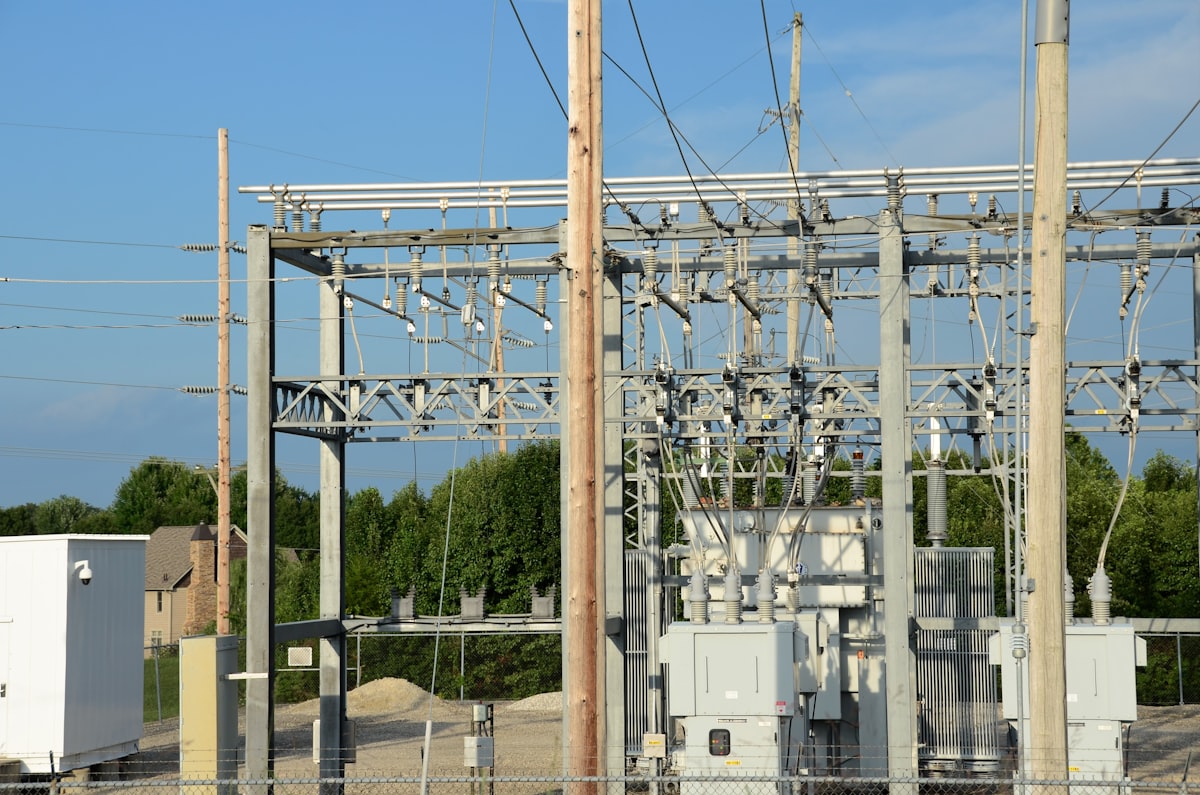
The conversation about US grid bottlenecks has spent most of 2024 and 2025 on the interconnection queue and on long-distance transmission. Both are real, both are slow, and both have at least the beginnings of a policy response in FERC Order 2023 and DOE’s SPARK reconductoring program. The third constraint, which is now arguably more binding for project completion timelines than either, has had much less attention. That constraint is large power transformer supply.
Lead times for the step-up transformers used at utility-scale substations have stretched well past the historical norms. Industry survey work by Wood Mackenzie, the Edison Electric Institute, and the DOE Office of Manufacturing and Energy Supply Chains has placed current lead times for 138 kV and 230 kV step-up units in the 24 to 30 month range across the major OEMs. Higher-voltage units in the 345 kV and 500 kV class are quoting longer, with some buyers reporting 36 to 48 month delivery windows. The pre-2020 baseline for the same equipment was roughly 12 to 18 months.
What a large power transformer actually is
A large power transformer (LPT) is a unit rated above 100 MVA, typically site-built and shipped in pieces, with installed weight in the hundreds of tons. They are the equipment that steps generation voltage up to transmission voltage at the plant fence, and that steps transmission voltage back down to subtransmission and distribution at the load substation. Every utility-scale solar farm, every grid-tied battery storage facility, every wind farm, every nuclear or gas plant, and every hyperscale data center connecting at transmission voltage needs them.
They are not interchangeable. Each unit is specified to the site, the voltage class, the impedance and tap range, the climate, and the buyer’s relay coordination. Substitution is rare. Order timing has to align with construction milestones, often two years ahead of mechanical completion.
The OEM footprint
The North American supply for LPTs is concentrated among a small number of producers. Hitachi Energy (the former ABB power grids business) operates the South Boston, Virginia plant for medium and large units, with capacity expansion announced in 2024 to ramp through 2027. Siemens Energy serves the market from European production with limited US assembly. GE Vernova services some of the market through its Prolec GE joint venture, with the largest North American production capacity at the Monterrey, Mexico facility. Smaller specialists include SPX Transformer Solutions (now part of GE Prolec), Pennsylvania Transformer Technology, Virginia Transformer Corp, and Howard Industries. Combined US-produced LPT capacity covers a minority share of US demand. The historical estimate, repeated in DOE supply chain reviews, is that the US imports roughly 80% of its large power transformers.
When demand spiked starting in 2022, the orderbook backlog built faster than any OEM could respond. The OEM response window is constrained on three sides.
The three real constraints
Grain-oriented electrical steel. Transformer cores require grain-oriented electrical steel (GOES) of a specific grade and thickness, and the global supply is dominated by a small set of mills in Japan, South Korea, Russia, and the United States. The single domestic producer, Cleveland-Cliffs Butler Works in Pennsylvania, runs at high utilization and has limited near-term expansion path. GOES is not a commodity steel and cannot be ramped on the timeline of cold-rolled flat product. Mill expansion projects measured in years, not quarters.
Skilled assembly labor. Winding, core stacking, tank fabrication, and oil filling for a large power transformer are skilled manual operations that take years to train. The OEMs have been hiring aggressively since 2023 and several have published apprenticeship and trade-school partnerships, but headcount additions take 18 to 36 months to convert into delivered units. There is no shortcut here. Robotic automation has been adopted incrementally for specific subassemblies but core winding remains primarily manual at high voltage classes.
Bushings, tap-changers, and ancillary components. High-voltage bushings (largely sourced from a small set of specialty producers in Sweden, Germany, and China) and on-load tap changers (Maschinenfabrik Reinhausen dominates the global market) are themselves on extended lead times. An OEM with capacity to assemble more units cannot deliver them without these components, and the upstream supply has its own bottlenecks.
What this does to project timelines
The practical consequence for developers is that 2027 and 2028 commercial operation dates are now being designed around transformer delivery rather than around panel, cell, or turbine delivery. A storage project that signs a contract in mid-2026 with a 2028 COD target needs the substation transformer ordered before final design, often before final permitting, and frequently before site control is fully secured. The capital cost of pre-ordering long-lead equipment without a firm project is high. The opportunity cost of not pre-ordering and missing COD is higher.
This shifts the developer behavior pattern. Large IPPs and utility-scale developers with healthy balance sheets are placing transformer orders speculatively, taking equipment delivery to staging yards, and matching units to projects after the fact. Smaller developers without that capacity are losing position. The result is a quiet consolidation pressure across the developer landscape that does not show up in headline transaction data.
Hyperscalers entering the substation procurement market directly, which is now standard at Google, Meta, Microsoft, and Amazon for their gigawatt-class campuses, have been able to outbid traditional buyers for delivery slots. Some utility procurement organizations have reported losing previously-scheduled OEM allocations to hyperscaler demand. The repricing effect on transformer unit costs has been documented at 30 to 60% above 2020 baseline pricing for comparable equipment.
Policy response, such as it is
The Defense Production Act Title III invocation by the Biden administration in 2022 directed federal investment toward LPT and related equipment manufacturing. Authorized funding flowed through DOE’s Manufacturing and Energy Supply Chains office and through DOD’s Industrial Base Analysis and Sustainment program. The amounts authorized were measured in low hundreds of millions, against an industry capital cost for meaningful new LPT capacity that runs into low billions per greenfield plant. Implementation has produced incremental capacity expansion announcements at existing OEMs rather than new domestic entrants.
There is no current federal program with the scale to materially shift LPT supply on the timeline that matters for 2027 to 2030 project completions. The DOE Loan Programs Office has the financial scale, but transformer manufacturing has not been a primary LPO portfolio category historically. Whether that changes under current funding constraints is open.
State-level policy has been quiet. Utility commissions in fast-growing load states (Texas, Arizona, Virginia, Georgia) have begun to flag transformer procurement as a reliability concern in their integrated resource plans, but commission jurisdiction does not extend to manufacturing capacity decisions.
Positioning implications
- Existing LPT OEMs with US production footprint (Hitachi Energy in Virginia, the Prolec GE Mexico facility serving the US market, the smaller US-based specialists) are in a multi-year orderbook position with strong pricing power. Equity exposure here is mostly indirect through Hitachi (Tokyo) and GE Vernova.
- GOES producers (Cleveland-Cliffs in the US, Nippon Steel and POSCO internationally) are positioned for sustained demand pull.
- Tap-changer and bushing specialists (Reinhausen privately held, ABB high-voltage products, a small set of European specialists) hold positions that are not easily disintermediated.
- Developers with pre-ordered LPT inventory have a project-completion advantage that does not show up in published project pipelines.
- Utilities that have not yet flagged transformer lead times in their IRP filings are likely understating their own near-term reliability risk.
Risks to the read
- A material slowdown in data center load growth (whether from AI compute efficiency gains, AI demand consolidation onto fewer hyperscalers, or capital cycle correction) would loosen the orderbook quickly. The OEM ramp underway is sized for current trajectory, not for a higher one.
- A meaningful federal program targeted at LPT manufacturing capacity, at the scale of the CHIPS Act for semiconductors, could shift supply over a 4 to 6 year horizon. There is no such program currently proposed.
- Substitution of distributed generation and behind-the-meter resources, which reduces the need for transmission-voltage step-up equipment, could lower LPT demand at the margin over time. The current load growth trajectory swamps any plausible distributed offset.
The frame: transformer supply is now the most binding physical constraint on US grid expansion for the 2026 to 2030 window. Unlike interconnection reform and transmission permitting, it does not have a policy lever that fixes it on the relevant timeline. Capital and policy both need to catch up to the fact that the equipment, not the projects or the queue, is what determines when the lights actually come on at the next data center campus.
Sources
- DOE Office of Manufacturing and Energy Supply Chains, America’s Strategy to Secure the Supply Chain for a Robust Clean Energy Transition, 2022 base report and subsequent updates, energy.gov/policy/supply-chain-deep-dive-assessments.
- Wood Mackenzie, US Power Equipment Lead Time Tracker, 2025 series.
- Edison Electric Institute, Transformer Supply Chain Survey, 2024 and 2025 industry briefings.
- US Department of Energy, Defense Production Act Title III determinations for electric grid components, 2022.
- Hitachi Energy press release, South Boston Virginia facility expansion, 2024.
- Cleveland-Cliffs Inc., Butler Works grain-oriented electrical steel production updates, 2024 and 2025 investor disclosures.