
Three policy clocks land inside the next 36 days. July 4 is the IRA safe-harbor cliff for utility-scale solar. FERC is due to rule on large-load interconnection (Docket RM26-4-000) by month-end. MISO files the first RTO compliance plan under FERC Order 1920 on June 12. The Carnegie Endowment sized what those clocks are racing: every announced hyperscaler nuclear deal totals 13 GW, less than a fifth of forecast US data-center demand through 2035. Private capital is already positioning: T1 Energy bought KORE Power’s NRI integrator for $32 million (a second solar-plus-storage tuck-in in two weeks), USA Rare Earth committed $1.2 billion to a Cherokee County heavy rare earth metals and magnet plant, South Australia awarded 5.3 GWh of 15-year 8-hour storage in its first FERM tender, and Painesville broke ground on a CPRG-funded coal-to-storage replacement. Policy is racing the demand curve; the marginal capex is already placed.
The lede
Last week’s digest closed on supply-side execution catching up to the AI-demand operating assumption: DOE plutonium fuel selections, NRC’s proposed Part 57 microreactor framework, the Enbridge-Meta 8-hour Cowboy project, SEIA’s record 9.7 GWh Q1, and Nextpower’s $365 million Prevalon acquisition. The theme was federal rulemaking and corporate M&A both moving in the same direction at once.
This week the shape rotated. The headline cluster is policy clocks: three separate federal and state proceedings with decision points inside the next 36 days, each one structurally important to a different vertical, and each one explicitly framed against data-center load growth. Solar developers have until July 4 to physically start construction on utility-scale projects under the IRS Notice 2025-42 framework. FERC is committed to rule on the large-load interconnection docket (RM26-4-000) by end of June. MISO files the first regional plan under FERC Order 1920 on June 12, which will set the template the other RTOs are watched against later in the year.
The Carnegie Endowment paper published June 2 (Pendleton and Schuessler) sized what those clocks are racing. Add up every announced hyperscaler nuclear deal, including PPAs and direct SMR partnerships, and the total comes to roughly 13 GW of potential capacity through the mid-2030s, about 102 TWh per year of generation if every project lands. That figure is less than 20 percent of projected US data-center demand through 2035. None of it delivers at meaningful scale before 2027. The bridge is gas, storage, behind-the-meter generation, and load curtailment, in some mix.
Private capital is already positioning around the gap. T1 Energy (NYSE: TE), a US-domiciled solar manufacturer, agreed to acquire BESS engineering firm KORE Power for roughly $32 million in equity, cash, and assumed debt, with closing in Q2 2026. The strategic core is KORE’s NRI division: a 50-year integrator with about 1,100 utility-scale storage projects and an existing book of US Government, National Lab, and utility customers. The sticker price is modest; the customer book and federal-eligibility profile are not. The deal lands two weeks after Nextpower-Prevalon at $365 million. Two solar producers buying BESS integrators inside fourteen days is no longer a coincidence; it is a pattern.
USA Rare Earth (Nasdaq: USAR) committed $1.2 billion to a sintered NdFeB magnet and refined metals operation in Cherokee County, South Carolina, with first production targeted for April 2028. Nameplate: 6,400 metric tons of magnets and 5,000 metric tons of heavy rare earth strip cast, metal, and alloy per year. It is the third US site on USAR’s mine-to-magnet path and the first explicitly sized for heavy rare earth metals at commercial scale, which is the piece of the rare-earth flowsheet that has historically lived almost entirely inside China. The named customer mix is aerospace, defense, semiconductors, and data centers.
South Australia’s Firm Energy Reliability Mechanism (FERM) Tender 1 closed on May 29 with six lithium-ion battery projects winning 15-year contracts. Headline numbers: 1,334 MW of nameplate power, 5,336 MWh of energy, 517 MW / 4,136 MWh of committed eight-hour dispatch. All six awards used lithium-ion chemistry. The structure (revenue-certain 15-year contract attached to an eight-hour committed dispatch obligation) is the cleanest working template yet for how a high-renewables grid pays for long-duration storage. The US RTOs are wrestling with exactly the same gap.
Painesville Municipal Electric began construction on a 10 MW battery and 35 MW solar facility funded by a $80 million Climate Pollution Reduction Grants (CPRG) award. The site is the brownfield of a retired municipal coal generator, with an existing interconnection slot. CPRG is the $5 billion EPA implementation program authorized under Section 60114 of the IRA. The $4.3 billion in implementation awards were obligated before the current administration took office, and obligated dollars continue to move into steel and concrete even where other clean-energy funding streams have been paused or rescinded. The Painesville build is a working example of timing arbitrage between obligation and rescission.
The framework does not bend this week. The policy layer takes the headline position; the private-capital layer keeps moving in the same direction as the prior weeks; the supply-side build pipeline adds another credible US node at the upstream end of the chain.
Top stories by vertical
Solar: The July 4 IRA safe-harbor cliff and the FERC large-load order land in the same five-week window
Two federal clocks run out in the same window and together set the rules for every utility-scale solar project the market is currently counting. (See: news/2026-06-02-solar-july-4-safe-harbor-countdown.)
Clock one is the July 4, 2026 cliff. Under the One Big Beautiful Bill Act and IRS Notice 2025-42 (issued September 2, 2025), utility-scale solar projects must begin construction by July 4 to claim the Section 48E investment tax credit on the legacy schedule, or accept a placed-in-service deadline of December 31, 2027. The 5 percent cost safe harbor is eliminated for facilities above 1.5 MW. Procurement deposits no longer establish a begin-construction date. The only remaining test is physical work of a significant nature, plus a continuous-program requirement. Steel in the ground, racking, foundations.
Clock two is FERC’s commitment to rule on Docket RM26-4-000 by end of June. The proceeding addresses interconnection of large loads above 20 MW, with rulemaking scope covering jurisdictional authority, cost allocation, and treatment of co-located generation and load. The data-center driver is named explicitly. PJM’s December 2025 order on co-located load is the live precedent the FERC ruling will either generalize or constrain.
EIA’s February 20 forecast of 43.4 GW of new utility-scale solar additions in 2026 (60 percent above 2025) reflects construction starts already in the ground. That number is largely locked. The number that is not locked is 2027 and 2028, which depends on what gets safe-harbored in the next four weeks and what FERC does to the interconnection queue in the next three.
Texas is the cleanest read. EIA puts 40 percent of 2026 solar additions there, and ERCOT interconnection is not under FERC jurisdiction; the safe-harbor clock binds, the FERC ruling does not. Outside ERCOT the FERC order matters more. The 1.5 MW carve-out structurally insulates distributed and community-scale solar from the cliff.
Against the published solar frame, both clocks point at the named risks: interconnection reform stalling (risk #1 in the solar frame) and IRA implementation getting reshaped at the margin. The first risk gets tested by FERC; the second gets tested by what the market actually safe-harbors against the IRS notice. The framework absorbs both data points and stays intact. The data point to track over the next 32 days is the 8-K cadence on physical work commencement at utility-scale solar projects.
Grid: MISO files the first Order 1920 regional plan on June 12, with 163 GW peak by 2035 baked in
MISO submits the first US RTO compliance plan under FERC Order 1920 on June 12, with the interregional companion filing due December 12. The operator is first into the staggered FERC schedule, which means its content choices set the template that PJM, SPP, ERCOT, and CAISO are watched against later in the year. (See: news/2026-06-06-miso-order-1920-june-12-data-center-load.)
Order 1920 (finalized 2024, clarified by 1920-A and 1920-B) requires transmission providers to run long-term regional planning on a 20-year horizon, evaluate a defined benefits set, accept a state-agreed cost allocation method if one exists, and treat scenarios that include policy-driven and demand-driven futures. The compliance filing is where each RTO turns those requirements into specific tariff text.
The load case MISO is bringing into the filing is the live story. The April 2026 long-range forecast workshop projected peak demand of 163 GW by 2035, up 35 percent from a 121 GW peak in 2025, with a high-trajectory scenario reaching 230 GW by 2046. MISO expects 8 to 14 GW of data-center load to come online in 2026 and 2027 alone. Under the mid-case, data centers reach roughly 20 percent of MISO electricity by 2030 and 25 percent by 2040. The central region (Illinois, Indiana, Michigan) carries the largest share of growth at 2.7 percent annually.
Against the grid thesis frame, this is the binding-constraint story written into a 20-year planning document. Risk #3 in the grid frame (load growth outpaces grid investment) does not get resolved or rejected by the filing; it gets crystallized as the explicit planning assumption that future MTEP cycles will build against. Watch on filing day: the cost allocation method MISO files, whether southern states secured a State Agreement Process carve-out, the scenario set used for project selection, and how right-sizing criteria are written. Each of those is a downstream signal for where transmission capital actually flows over the next planning cycle. Frame holds; one named risk acquires a 20-year planning anchor.
Nuclear: Carnegie sizes the hyperscaler nuclear gap at 13 GW, less than 20 percent of 2035 data-center demand
The Carnegie Endowment for International Peace published a paper on June 2 (Pendleton and Schuessler) that does the arithmetic the press-release cycle has been avoiding. Adding up every announced hyperscaler nuclear deal, including PPAs and direct SMR partnerships, the total comes to roughly 13 GW of potential capacity through the mid-2030s. If all of it materializes, the output is about 102 TWh per year. Less than 20 percent of forecast US data-center demand through 2035. (See: news/2026-06-03-carnegie-hyperscaler-nuclear-gap.)
The 13 GW splits in two halves. PPAs account for about 6.9 GW: Amazon’s 1.9 GW Talen agreement, Meta’s 1.121 GW Constellation credit deal plus 2.6 GW of life extensions, Microsoft’s 835 MW Three Mile Island restart, Alphabet’s 50 MW Kairos and TVA contract. Direct partnerships account for 6.1 GW: Alphabet’s 1.8 GW Elementl arrangement (three 600 MW sites by 2035), Amazon’s roughly 5 GW X-energy framework with Energy Northwest, Meta’s 2.8 GW TerraPower commitment by 2035, and the 1.2 GW Meta-Oklo path by 2034.
The timing mismatch is the structural story. Conventional reactor builds run 10 to 15 years and no commercial-scale SMR is yet operating in the US. Carnegie cites over 700 data centers under construction as of March 2026, with sector demand projected to triple or quadruple by 2035. Paper quote: “Nuclear is a marathon. Signing up for the marathon does not move the sprint’s finish line.”
Three reads against the nuclear thesis frame. First, this is volume gap, not announcement gap. Hyperscalers are not under-contracting in headline terms; they are under-delivering in MWh terms because the contracts run on 2028 to 2035 timelines while the load is showing up now. Second, SMR vendors are option value, not baseload. X-energy, TerraPower, Oklo, and Kairos collectively anchor about half the announced volume, and none has a commercial-scale US operating reference yet. Each project that slips moves more demand onto grid-scale storage and behind-the-meter generation in the meantime. Third, grid-scale storage is the residual claimant. Every GW of nuclear that fails to arrive on time is a GW that storage, gas peaking, or load curtailment has to cover.
The thesis frame for nuclear was built around the claim that the renaissance is real and hyperscaler procurement is the institutional confirmation. Carnegie does not invalidate that claim; it sizes the gap between procurement and deliverable MWh. Risk #5 (hyperscaler demand collapses faster than anticipated) does not get pulled; the opposite risk (announced supply fails to deliver against announced demand) gets sharpened.
Critical Minerals: USA Rare Earth picks South Carolina for $1.2 billion heavy rare earth metals and magnet plant
USA Rare Earth (Nasdaq: USAR) announced on June 2 that it will spend roughly $1.2 billion to build a sintered NdFeB magnet and refined metals operation at the Bailey Industrial Park in Blacksburg, Cherokee County, South Carolina. Nameplate: 6,400 metric tons of finished NdFeB magnets per year and 5,000 metric tons of heavy rare earth strip cast, metal, and alloy per year. First production targeted for April 2028. About 490 jobs. (See: news/2026-06-05-usa-rare-earth-cherokee-county-magnet-plant.)
The announcement is the third US site on USAR’s stated mine-to-magnet path (Round Top deposit in Texas, Stillwater magnet manufacturing in Oklahoma, and now Cherokee County). The Cherokee County build adds upstream refining and metal capacity that the existing Stillwater footprint does not contain, and is the first US site explicitly designed to produce heavy rare earth metals and alloys at meaningful scale.
The heavy rare earth piece is the part that matters for the supply chain frame. Sintered NdFeB magnets contain roughly 2 to 8 percent dysprosium or terbium for the high-temperature grades used in EV traction motors, defense actuators, and wind turbine direct-drive generators. Those heavy elements are concentrated in southern Chinese ionic clay deposits and have historically been refined almost entirely inside China. Beijing’s April 2025 export licensing regime tightened controls on heavy rare earth oxides and processing technology, and the licenses have continued to act as a binding rather than nominal constraint through 2026.
Two thesis points to flag. First, the marginal capex going into the chain now sits behind US borders and is rated for non-China end markets: USAR, MP Materials’ planned Independence facility, and the South Australian and European projects funded by allied government programs all show the same shape. None of the announced 2027-2028 capacity is online yet, but the pipeline is starting to add to a number worth tracking against China’s installed base. Second, the named customer mix (aerospace, defense, semiconductors, data centers) is the same mix the rare-earth bull case is built on. AI-related capex is now showing up as a named end market in rare earth project announcements at this scale.
Caveats. The 2028 first-production target leaves permitting, capital availability, and construction execution as live risks. Heavy rare earth recovery flowsheets at commercial scale outside of China have been demonstrated only in pilot to date; the dysprosium and terbium ramp is the metric that will either confirm or quietly reset the timeline. Against the published critical-minerals frame, the US-supply build vector strengthens at the upstream-refining end of the chain, where the structural gap with China has been the widest. Watch the next USAR quarterly update for Round Top permitting progress and any disclosed offtake or DoD-backed price support attached to the Cherokee site.
Storage / Lithium: T1 Energy buys KORE Power for $32 million; second solar-plus-storage tuck-in in two weeks
T1 Energy (NYSE: TE), a US-domiciled solar manufacturer, said on June 3 that it has agreed to acquire KORE Power for approximately $32 million in equity, cash, and assumption of debt. Closing is targeted for Q2 2026, after which KORE will be rebranded T1 NRI. The strategic core is KORE’s NRI division: a 50-year integrator with about 1,100 utility-scale storage projects, with a customer book covering the US Government, National Laboratories, regulated utilities, and independent developers. (See: news/2026-06-07-t1-energy-kore-power-bess-acquisition.)
T1 expects positive EBITDA in 2026 and $15 million to $20 million of EBITDA contribution in 2027. That is order-of-magnitude check, not a transformational acquisition. The value sits in the customer book and the federal-eligibility profile, not in run-rate earnings. For a solar producer that needs to credibly bid solar-plus-storage projects to hyperscalers and federal customers, buying a 1,100-project install base is a faster path to a BESS resume than internal build.
The reason it matters past the $32 million sticker: T1-KORE arrives two weeks after Nextpower-Prevalon (May 28, $365 million for 6 GWh of deployed BESS and 1.3 GW of firm hyperscaler-anchored contracts). Two US solar manufacturers buying BESS integrators inside fourteen days is a structural pattern, not a coincidence. The shared logic: hyperscaler and utility procurement is moving toward integrated solar, storage, and interconnection-ready engineering as a single bid rather than three sequential ones; FEOC and IRA tax-credit eligibility favor US-domiciled component-and-integration stacks; and FERC’s expected end-of-June ruling on large-load interconnection adds further reward to vertically integrated bidders.
Against the storage thesis frame, this is a second weight-bearing data point inside two weeks for the structural-integration vector. Risk #4 (alt-storage capturing grid share at long duration) is not at issue here; T1-KORE and Nextpower-Prevalon are both lithium-anchored bets. Watch for the third tuck-in. If a third US solar manufacturer signs a comparable integrator acquisition before the end of Q3, the pattern becomes the consensus read, and the BESS-integrator universe will be priced for the consolidation.
Storage / Lithium: South Australia awards 5.3 GWh of 15-year, 8-hour lithium storage in first FERM tender
South Australia’s Firm Energy Reliability Mechanism Tender 1 closed on May 29 with six lithium-ion projects winning 15-year Firm Energy Reliability Mechanism Agreements (FERMAs). Headline numbers: 1,334 MW of nameplate power, 5,336 MWh of energy, and 517 MW / 4,136 MWh of committed capacity (the slice contractually obligated to dispatch for eight continuous hours during system stress). (See: news/2026-06-01-south-australia-ferm-tender-1-ldes.)
The six awards: Neoen Goyder Stage 1 and 2 (150 MW / 1,200 MWh combined, COD November 2028), Ampyr Northern Battery (125 MW / 1,000 MWh, COD November 2028), Iberdrola Tungkillo BESS (100 MW / 800 MWh, COD November 2028), Akaysha Brinkworth BESS (92 MW / 736 MWh, COD November 2029), ZEBRE Dartmoor BESS (50 MW / 400 MWh, COD November 2029). All six use lithium-ion chemistry. All carry the eight-hour committed-dispatch spec on the contracted slice.
The state context: South Australia already runs above 70 percent renewables and is targeting net 100 percent by 2027. Thermal retirements have opened a firm-capacity gap that real-time energy prices alone are not closing. The FERM is the policy answer, and Tender 1 produced the first cleared price signal for how that gap fills with storage instead of peakers or synchronous condensers.
Two reasons this matters past the local headline. First, the contract design. A 15-year revenue-certain agreement attached to an eight-hour committed dispatch is the kind of instrument US developers have been asking for. PJM’s capacity construct, ERCOT’s energy-only market, and CAISO’s resource adequacy framework all currently underprice the long-duration build. The FERM is a working international reference point. Second, the chemistry signal. Six awards, all lithium-ion, at eight-hour duration. Sodium-ion, flow, and thermal alternatives did not win this round. The cost curve on lithium LFP at long duration is now competitive enough to clear a competitive tender against firm-capacity alternatives.
Against the storage thesis frame, this is partial counter-pressure on risk #4 (alt-chemistry capturing long-duration share). The SEIA Q1 outlook flagged hyperscalers moving past LFP at the 6-to-16-hour band toward iron-air and reversible solid-oxide. The FERM result says that at the 8-hour band, in a competitive tender against firm-capacity alternatives, lithium is still the clearing chemistry today. The two reads are not contradictory; hyperscaler PPAs and competitive capacity tenders are different procurement instruments with different optimization functions. Risk #4 stays at “named and partially funded” but acquires one weight-bearing counter-data-point at the 8-hour band.
Climate Policy: Painesville breaks ground on $80M CPRG-funded coal-to-storage replacement
Painesville Municipal Electric began construction this month on a 10 MW battery and 35 MW solar facility built on the brownfield site of its former coal-fired generator. The project is part of a $129 million Climate Pollution Reduction Grants (CPRG) package awarded to a Cuyahoga County-led regional consortium: $80 million to Painesville, $30 million to Cuyahoga County, $20 million to the City of Cleveland. The Cleveland and County dollars fund an additional 28 MW of solar across five brownfield and landfill sites. (See: news/2026-06-04-painesville-cprg-coal-replacement.)
CPRG is the $5 billion EPA implementation program authorized under Section 60114 of the IRA. Selections closed in mid-2024, and the $4.3 billion in implementation awards were obligated before the current administration took office. Obligated CPRG dollars are still moving into steel and concrete, even where other clean-energy funding streams have been paused or rescinded. Painesville is a working example of timing arbitrage between obligation and rescission.
The supply-chain read is straightforward. Storage replacing small municipal coal units is one of the lowest-friction deployment paths in the country. The interconnection slot already exists (the coal unit was using it). The parcel is already industrial brownfield (siting and permitting friction is low). A municipal utility can own the asset directly without rate-base proceedings. The 10 MW battery sits on the modest end of the size curve, but small muni coal units number in the hundreds nationally, and the playbook generalizes. The 35 MW solar to 10 MW storage pairing (about 29 percent storage-to-PV ratio) reads as a sign that interconnection has local headroom and the local capacity need is modest, not as a template default.
Against the published IRA-implementation frame, this is thesis-confirm. The obligation-vs-rescission lever (CPRG specifically) keeps producing physical builds inside 2026. Watch how many of the other CPRG-funded brownfield builds break ground in the next two quarters, and whether any face funding clawback challenges. Obligated does not always mean spent.
Framework check
Solar (risk #1: interconnection reform stalls). Active live test. FERC’s end-of-June ruling on Docket RM26-4-000 is the binary event. A ruling that generalizes the PJM December 2025 co-located precedent loosens the constraint; a ruling that narrows it tightens. The IRS Notice 2025-42 framework is a parallel test of IRA implementation rather than interconnection per se. Frame intact; watch the docket.
Solar (IRA implementation). The July 4 safe-harbor cliff is the next 32 days of headline risk. 2026 deployment (EIA’s 43.4 GW) is largely locked. 2027 and 2028 are the numbers at risk. Watch the 8-K cadence on physical-work-of-significant-nature disclosures.
Grid (risk #3: load growth outpaces grid investment). Sharpens at the 20-year planning anchor. MISO’s Order 1920 filing on June 12 turns the load-vs-build gap into the explicit planning assumption that MTEP cycles will build against. The risk is not resolved; it is now anchored. Frame intact.
Nuclear (thesis: renaissance is real, hyperscaler procurement is the institutional confirmation). Carnegie does not pull the thesis; it sizes the deliverable gap. Announced procurement is genuine; deliverable MWh through 2035 is less than 20 percent of forecast demand. The relevant edge moves to which named project actually delivers on schedule, and to which behind-the-meter and grid-scale bridge captures the residual demand.
Nuclear (risk #5: hyperscaler demand collapses faster than anticipated). Held at last week’s marked-down notch. Carnegie’s >5x supply-vs-demand gap is the opposite signal of demand collapse. No new data point pulled toward collapse.
Critical Minerals (US-supply build vector). Strengthens at the upstream-refining end. USAR Cherokee County adds the first US site sized for heavy rare earth metals at commercial scale. The Carolinas now host both Kings Mountain lithium permitting clearance (March) and the announced heavy rare earth refining footprint (June), at the same window where the USGS published the 2.3 million tonne Appalachian lithium assessment. The regional cluster reads as more than coincidence.
Critical Minerals (NdPr above the DoD floor at MP Materials). Carries forward from last week. No new MIIT quota signal this week. The structural read holds.
Storage / Lithium (risk #4: alt-storage capturing grid share at long duration). Mixed signal. SEIA’s hyperscaler chemistry callout from last week stands. South Australia FERM Tender 1 is partial counter-pressure: all six 8-hour awards went to lithium-ion in a competitive firm-capacity tender. The two reads are not contradictory; they describe different procurement instruments. Risk #4 stays at “named and partially funded”; the 8-hour band acquires one weight-bearing counter-data-point.
Storage / Lithium (structural integration vector). New: T1-KORE follows Nextpower-Prevalon two weeks later. Two US solar producers buying BESS integrators inside fourteen days reads as a pattern. If a third follows by end of Q3, the consolidation becomes the consensus read.
Climate Policy (IRA implementation thesis). Confirmed. Painesville CPRG is the obligation-vs-rescission lever producing physical builds inside 2026. The structural read continues.
Net read: thesis intact across all five active verticals. The policy layer takes the headline position with three federal and state clocks landing inside 36 days. The supply-side build pipeline adds a credible upstream US node (USAR Cherokee). The structural-integration vector in storage acquires a second confirming data point. The Carnegie sizing of the nuclear gap reframes the hyperscaler-procurement thesis around the deliverable timeline rather than the announcement headline.
Cross-vertical thread
The thread of the week is policy racing the demand curve, with private capital already positioned for whichever way the clocks land. Three federal and state actions converge inside the next 36 days. The July 4 cliff sets which 2027 and 2028 solar deployments make the IRA credit schedule. FERC’s RM26-4-000 ruling at end of June sets the rules of the road for every gigawatt-scale co-located data-center build behind it. MISO’s June 12 Order 1920 filing anchors the 20-year transmission planning assumption that the MTEP cycle will build against, with an embedded 163 GW peak by 2035 and 8 to 14 GW of data-center load named for 2026 and 2027 alone.
The Carnegie paper sized the underlying gap those clocks are trying to manage. Every announced hyperscaler nuclear deal totals 13 GW, less than 20 percent of forecast 2035 data-center demand. The bridge is gas, storage, and anything else permittable. The implication holds across the supply-side data points the week produced. South Australia FERM showed how a 15-year, 8-hour competitive tender clears against firm-capacity alternatives. Painesville CPRG showed how IRA-obligated dollars keep moving into brownfield coal-to-storage replacements at low interconnection-friction sites. USAR Cherokee County showed where the upstream refining capacity gets built when the customer mix names data centers explicitly. T1-KORE showed how US solar manufacturers are positioning for integrated solar-plus-storage bids in the same procurement window the FERC ruling will define.
The negative-space read holds. There was no major hyperscaler PPA announcement this week, no major DOE loan, no FERC reform other than the named ruling on the docket. The week’s signal cluster ran through the rulemaking layer, the project-financing layer, the M&A layer, and the international policy-template layer. The published thesis frames absorb every data point without bending. Track marginal: USAR Cherokee, T1-KORE, FERM Tender 1, Painesville CPRG. Watch policy: July 4, RM26-4-000, MISO Order 1920, Carnegie. Ignore most price noise: there was little this week, and what was there did not move any frame.
The shape of the thread to hold for next quarter. AI demand reshaped federal rulemaking and corporate capital structure across the prior two weeks. This week, the same vector compresses into a binary set of policy decisions inside a five-week window. If the clocks land in favor of fast deployment (FERC generalizes co-location, IRS notices hold the line on physical-work tests, MISO files an aggressive scenario set), the deployment curve through 2028 stays close to the EIA and SEIA forecasts the market is anchored against. If they land restrictively, the deployment curve flattens and the residual demand routes toward whichever generation source can be permitted on a faster clock. Private capital this week placed bets that read as agnostic to that binary, which is itself a signal that the operators with the cleanest visibility expect at least one of the three clocks to land in the deployment-favorable direction.
Watch list: week of June 8-14, 2026
- MISO Order 1920 compliance filing on June 12. The first RTO to file under the new federal transmission planning framework. Watch the cost allocation method, the scenario set used for project selection, any State Agreement Process carve-out for the southern states, and how right-sizing criteria are written. Each is a downstream signal for where transmission capital flows over the next planning cycle. (Grid.)
- FERC Docket RM26-4-000 (large-load interconnection) ruling by end of June. Binary event for every co-located data-center solar-plus-storage project pricing the regulatory regime today. Generalization of the PJM December 2025 co-located precedent loosens the build path nationally; narrowing it tightens. (Solar / Grid.)
- NRC Part 57 public comment closes June 15. Watch which microreactor developers, utility associations, and NGO interveners file comments, particularly on manufacturing licenses, fleet approvals, and autonomous operation. Those three together carry most of the projected 6-to-12-month licensing compression. (Nuclear.)
- Utility-scale solar 8-K cadence on physical-work-of-significant-nature disclosures. The next four weeks are the 32-day countdown to the July 4 IRA safe-harbor cliff. Watch for ground-breaking, racking, and foundation disclosures that establish a begin-construction date under IRS Notice 2025-42. The volume and concentration of disclosures sizes what makes the December 31, 2027 placed-in-service window. (Solar.)
- Any third US solar manufacturer announcing a BESS integrator acquisition. T1-KORE and Nextpower-Prevalon set the template. A third event before end of Q3 turns the pattern into consensus. (Storage.)
- USAR next quarterly update on Round Top permitting and any disclosed offtake or DoD support for the Cherokee site. First read on whether the heavy rare earth metals project lands with structured demand attached. (Critical Minerals.)
Clean Power Press is editorial, not advisory. Nothing here is a recommendation. Positions, prices, and projects move; we cover how to think about them.
Sourcing log
- South Australia FERM Tender 1 results: Energy-Storage.News, May 29 2026.
- Solar July 4 IRA safe-harbor cliff: IRS Notice 2025-42 (September 2 2025); FERC Docket RM26-4-000 Order Regarding Intent to Act (April 16 2026); EIA Today in Energy (February 20 2026).
- Carnegie Endowment hyperscaler nuclear gap: Pendleton and Schuessler, Carnegie Endowment for International Peace, June 2 2026.
- Painesville CPRG coal-to-storage: City of Painesville announcement; EPA Climate Pollution Reduction Grants program materials.
- USA Rare Earth Cherokee County: USA Rare Earth press release (GlobeNewswire, June 2 2026); South Carolina Department of Commerce announcement.
- MISO Order 1920 regional plan filing schedule: Utility Dive coverage of MISO long-range forecast workshop (April 2026).
- T1 Energy / KORE Power: Energy-Storage.News, June 3 2026 announcement coverage.
- Prior digest framework, watch list, and named risks:
posts/weekly-2026-05-31.md. - Vertical thesis frames: project file
vertical-thesis-frames. - In-period news flashes:
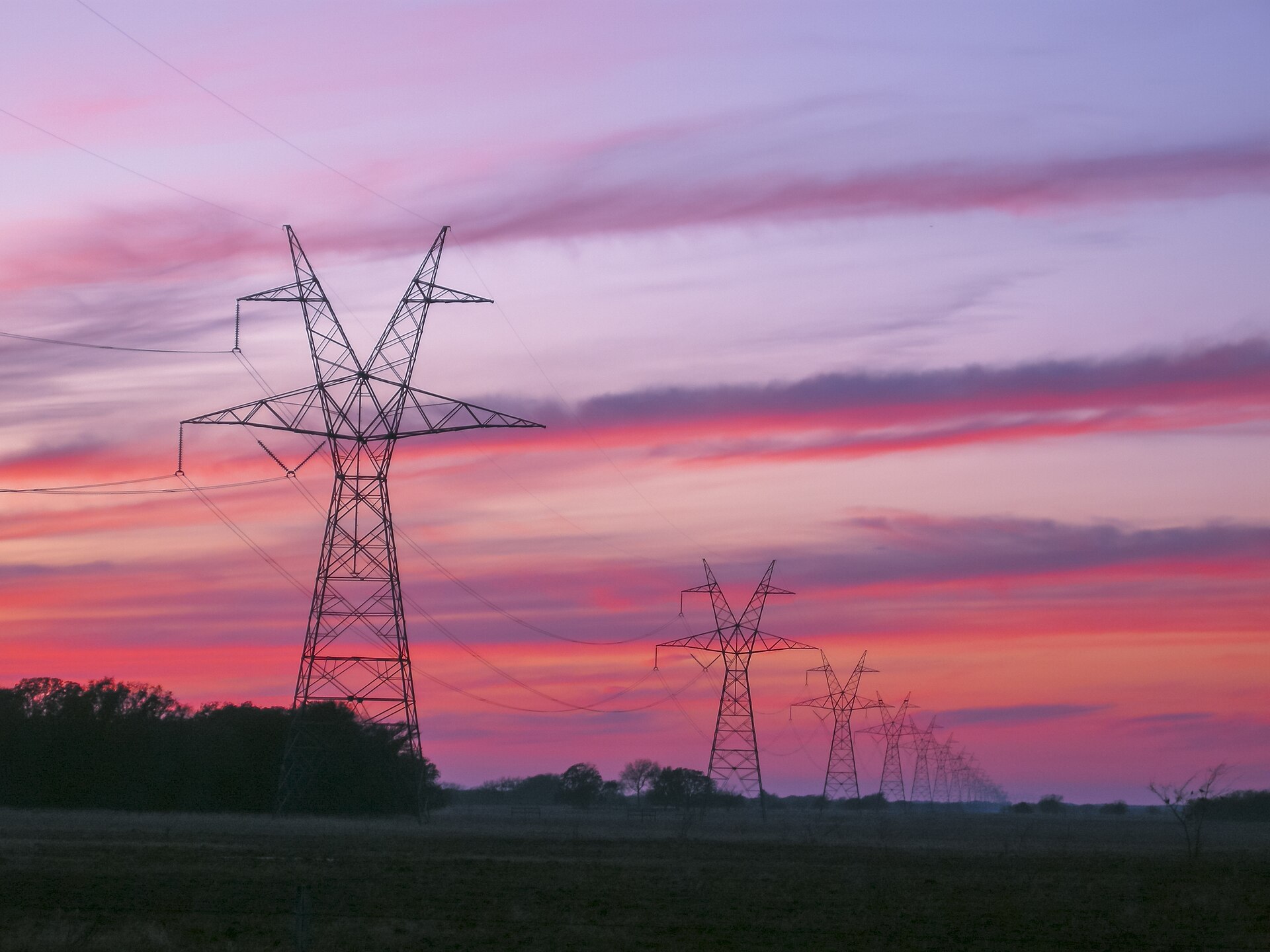
news/2026-06-01-south-australia-ferm-tender-1-ldes,news/2026-06-02-solar-july-4-safe-harbor-countdown,news/2026-06-03-carnegie-hyperscaler-nuclear-gap,news/2026-06-04-painesville-cprg-coal-replacement,news/2026-06-05-usa-rare-earth-cherokee-county-magnet-plant,news/2026-06-06-miso-order-1920-june-12-data-center-load,news/2026-06-07-t1-energy-kore-power-bess-acquisition. - Cover image: “Transmission towers and lines at sunset in East Texas” by Matthew T Rader, Wikimedia Commons, CC BY-SA 4.0.