
The first of last week’s three policy clocks landed: FERC approved PJM’s Expedited Interconnection Track on June 9, a state-gated fast lane for ten 250 MW projects per year that can reach commercial operation in three years. The demand-side clock (FERC RM26-4-000 on large-load interconnection) is now on the calendar for the June 18 open meeting under the Sunshine Notice rule. Across the supply stack the same theme repeated in different chemistries and balance sheets: CATL signed the first commercial-scale sodium-ion offtake (60 GWh to HyperStrong), Panasonic disclosed plans to convert part of its 32 GWh De Soto cell factory from EV to data-center BESS, and the Pentagon added JA Solar, Trina, EVE, and CALB to the Section 1260H list with the direct DoD contracting ban starting end of June. The legal read on the One Big Beautiful Bill Act confirmed that storage kept both safe-harbor paths while solar above 1.5 MW lost both. ACP’s Q1 2026 quarterly put solar and storage at 93 percent of new utility-scale grid additions. Thesis intact across all five active verticals.
The lede
Last week’s digest framed three federal and state policy clocks running inside a 36-day window: the July 4 IRA safe-harbor cliff for utility-scale solar, FERC’s commitment to act on RM26-4-000 by end of June, and MISO’s first Order 1920 regional plan filing on June 12. Two of those clocks moved this week. MISO filed on schedule (the substance is still being parsed in trade press as of the digest cutoff). FERC delivered the first of the two pending interconnection decisions five days earlier than expected, approving PJM’s Expedited Interconnection Track at its June 9 meeting. The larger demand-side ruling on RM26-4-000 is now scheduled for the June 18 open meeting under the seven-day Sunshine Notice rule.
The clocks landed in the order the prior digest sized: supply side first (250 MW thermal and uprated nuclear projects with state backing), demand side a week and a half later. The PJM EIT and the still-pending RM26-4-000 are part of a single federal effort to compress the negotiation surface between the data-center buildout and the transmission system, and the sequencing is meaningful. The Commission cleared a narrow path for new generation to reach the grid faster before it tries to write rules for how the load side connects.
The supply stack moved on a parallel track. CATL agreed to supply 60 GWh of sodium-ion cells to HyperStrong, the first commercial-scale offtake commitment for the chemistry. Panasonic Energy said it is exploring converting part of its De Soto, Kansas cell factory from EV batteries to stationary storage cells aimed at data-center customers. The Pentagon’s June 8 Section 1260H update added JA Solar, Trina Solar, EVE Energy, and CALB to the roster of Chinese military companies, with the direct DoD contracting ban beginning at the end of June. Stoel Rives circulated a legal summary confirming that storage retained both the physical-work test and the 5 percent cost safe-harbor at any project size under the One Big Beautiful Bill Act, and that the Section 48E phase-out and 2027 placed-in-service backstop do not apply to energy storage technology.
The American Clean Power Association’s Q1 2026 quarterly, released June 3, put utility-scale solar at 3.6 GW and battery storage at 2.4 GW for the quarter (93 percent of new megawatts combined), with wind picking up the remainder. Total operational clean capacity in the US is now over 370 GW, and Texas is closing on 100 GW operational.
No major news in nuclear or critical minerals this week. The five active verticals in the prior digest produced meaningful data points in four (solar, storage, grid, climate policy). Nuclear was structurally quiet (NRC Part 57 comment window still open; no new hyperscaler PPA). Critical minerals was quiet at the project level (USA Rare Earth Cherokee County still the active marker from last week).
Top stories by vertical
Grid: FERC approves PJM Expedited Interconnection Track, then sets large-load ruling for June 18
The Commission approved PJM’s Expedited Interconnection Track on June 9, opening a two-year carveout for up to ten generation projects per year of at least 250 MW that can reach commercial operation within three years and carry written backing from a state’s primary siting authority. PJM expects each accepted project to move from filing to a generator interconnection agreement in roughly ten months. The program expires at end of 2027 unless extended. (See: news/2026-06-13-ferc-pjm-expedited-interconnection-track.)
The EIT is fuel-source neutral on paper. In practice, the 250 MW floor and three-year COD requirement narrow the eligible set to combined-cycle gas and uprated nuclear. New build SMRs, most utility-scale solar paired with storage, and offshore wind cannot clear the three-year clock. Commissioner Rosner’s concurrence flagged that the state-siting backstop pushes coordination onto public utility commissions and state legislatures.
Opposition was broad: Vistra, the Illinois Commerce Commission, LS Power, New Jersey BPU, clean-energy trade groups, and community organizations all filed against. FERC characterized concerns about queue delays for non-EIT projects as speculative.
The larger ruling lands June 18. FERC’s binding April 16 commitment to act on Docket RM26-4-000 by end of June points to the regularly scheduled June 18 open meeting as the venue. (See: news/2026-06-10-ferc-rm26-4-large-load-june-deadline.) The April order described the action as one that will be “quick, efficient and legally durable,” wording that points to a narrow first round rather than a sweeping rewrite. Four areas are in play: jurisdictional clarity on cost allocation between FERC and the states, treatment of co-located load and generation, queue priority for loads above 20 MW, and a workable federal definition of “large load.” The PJM December 18 colocation order is the live template the rulemaking will either generalize or constrain.
Against the grid thesis frame, the EIT is a partial loosening of risk #1 (interconnection reform stalls) at the supply side. The pending RM26-4-000 is the binary event on risk #1 at the demand side. Watch which states file the first EIT endorsements: Pennsylvania, Ohio, Virginia, and New Jersey are the likely first movers, and the generation type those endorsements favor will be a leading indicator of whether the federal fast lane is functionally a gas runway or a balanced eligibility carve-out.
Solar: ACP Q1 shows solar plus storage at 93 percent of new capacity; Pentagon 1260H bites JA Solar and Trina
ACP’s Q1 2026 quarterly put utility-scale clean additions at 6.4 GW, with solar contributing 3.6 GW (56 percent) and storage 2.4 GW (37 percent). Wind picked up the remainder. Total US operational clean capacity is now over 370 GW. Texas leads with 96.4 GW; California is second at 46.4 GW. ACP cited “regulatory delays” as the binding constraint on new wind starts. (See: news/2026-06-09-acp-q1-2026-solar-storage-93pct.)
Quarterly volume was down 17 percent versus Q1 2025 and 66 percent versus Q4 2025, which ACP attributes to seasonal patterning after a strong year-end push. The durable signal is the mix: solar pipeline up 13 percent year over year, storage pipeline up 8 percent, wind shrinking. That mix shift is what the IRA construction-start clock is now sorting on.
Texas closing on 100 GW operational is the cleanest read of the framework. EIA puts 40 percent of 2026 solar additions in Texas, where ERCOT interconnection is not under FERC jurisdiction and the July 4 safe-harbor clock binds without the RM26-4-000 overlay. ERCOT’s energy-only market continues to do as much of the structural work as federal credits are.
The Pentagon’s June 8 expanded Section 1260H list grew the roster of Chinese military companies from about 130 to 188, with JA Solar and Trina Solar (two of the largest module vendors with US-market presence) added alongside battery cell makers EVE Energy and CALB and a broader set of industrials including BYD. CATL was already on the list from January 2025. The direct DoD contracting prohibition under the FY2024 NDAA takes effect at the end of June; the indirect (third-party) prohibition layers in twelve months later. (See: news/2026-06-12-pentagon-1260h-solar-battery-additions.)
The action does not impose tariffs, sanction the named firms under OFAC, or block product from the US commercial market. It does carry weight beyond DoD procurement: 1260H designation is a recurring reference point in federal grant conditions, export-control diligence, allied-government screening, and capital-markets disclosure. For solar specifically, both JA Solar and Trina have or had US-located manufacturing partnerships designed to qualify product for IRA credits. The 1260H designation tightens the screen for any project taking federal dollars or supplying federal facilities, and it stacks with the OBBBA Prohibited Foreign Entity material-assistance thresholds (55 percent domestic content for 2026 starts, escalating to 75 percent by 2029).
Against the solar thesis frame, ACP Q1 is thesis-confirm at the deployment level. The 1260H expansion is incremental thesis-confirm at the supply-source rebalancing level: federal procurement is a small slice of total demand, but the signal compounds with FEOC rules, tariff posture, and capex certainty. Worth watching: whether IRS or Treasury cross-references the 1260H roster in the next round of FEOC implementation guidance. Cross-reference would harden a soft federal-procurement rule into a credit-eligibility test that touches the full commercial market.
Storage / Lithium: Sodium-ion crosses a commercial threshold; Panasonic repoints US EV capacity at data centers; OBBBA preserves storage safe-harbor optionality
Three weight-bearing data points in one vertical inside one week. Taken together they describe a chemistry, capacity, and policy stack that all moved in the same direction.
Sodium-ion: first commercial offtake. CATL agreed to supply 60 GWh of sodium-ion cells to HyperStrong, China’s largest BESS integrator. Industry analysts now describe this as the first commercial-scale offtake commitment for grid-storage sodium-ion. (See: news/2026-06-08-catl-hyperstrong-60gwh-sodium-ion.) The deal does not undercut LFP on price today: sodium-ion cells are priced around $70/kWh versus roughly $40-50/kWh for LFP, with energy density at about half of LFP, which means a sodium-ion project needs about twice the container count for the same MWh. What the deal does is justify dedicated manufacturing lines and pass-through component supply, which is the missing piece sodium-ion needed to convert theoretical raw-material cost advantage into actual scale. The Clean Power Press lithium thesis lists sodium-ion taking grid-storage share faster than expected as a medium-probability, large-impact risk. This is the first hard data point that the optionality is real, not slideware. Three things to watch: where the 60 GWh actually lands (standalone four-hour systems for renewable firming would be substitution against LFP at the margin; specialty applications would not), how fast the $70/kWh figure compresses, and whether a non-Chinese cell maker commits to a comparable offtake (which would convert this from a China-only manufacturing story into a global chemistry diversification story).
Panasonic De Soto: EV capacity repoints at data centers. Panasonic Energy disclosed on June 12 that it is exploring converting part of its 32 GWh De Soto, Kansas cell factory from EV batteries to stationary storage cells aimed at data-center customers, with conversion-line production targeted for Q3 2029 and first sample cells in mid-to-late 2028 or early 2029. (See: news/2026-06-14-panasonic-de-soto-data-center-pivot.) De Soto opened in July 2025, is currently running at roughly half capacity (four of a planned eight production lines installed), and was sized for around 4,000 employees at full ramp. The trigger is two-sided: EV cell offtake has come in below the volumes assumed when the plant was scoped, and the OBBBA Prohibited Foreign Entity provisions limit which competitors can compete for IRA-eligible US demand. The combination leaves Panasonic with US capacity, a clean ownership structure, and softer-than-modeled EV pull. Ultium Cells, Samsung SDI, SK On, and LG Energy Solution have each signaled or executed similar EV-to-stationary repointing in the last twelve months. Panasonic is the cleanest US case because the plant is wholly owned, IRA-aligned, and not yet fully built out, so the conversion can be planned into the back half of the buildout rather than retrofitted onto fully tooled lines. Watch for the first named hyperscaler or utility BESS contract attached to De Soto output.
OBBBA storage carve-out confirmed. The Stoel Rives summary circulating through legal-summary work this week confirmed that the One Big Beautiful Bill Act left battery storage with qualification optionality that solar and wind above 1.5 MW have lost. Standalone storage retains both the physical-work test and the 5 percent cost safe-harbor at any project size, and the Section 48E phase-out and December 31, 2027 placed-in-service backstop do not apply to energy storage technology. (See: news/2026-06-11-storage-itc-safe-harbor.) The Act does extend Prohibited Foreign Entity restrictions to storage, with material-assistance thresholds stepping up from 55 percent domestic content for 2026 starts to 75 percent for 2029 and later. Net read: storage was already the demand vector the lithium thesis weighs heaviest, and the policy stack just widened the gap between storage and the rest of the credit-eligible clean-power capex. A storage project sited in 2026 now has a markedly different credit-risk profile than a solar project sited in 2026, and the difference will show up in capital costs. Watch for IRS guidance on storage-specific material-assistance rules, and for refinancing structures that explicitly price the credit-certainty differential between standalone storage and storage co-located with solar.
Against the storage thesis frame, all three data points run in the same direction. The Panasonic repoint and the OBBBA storage carve-out both confirm the structural-integration vector inside US borders. The CATL-HyperStrong sodium-ion deal is the first weight-bearing counter-data-point on risk #4 (alt-chemistry capturing grid-storage share faster than expected), but it lands in China and is anchored to a $70/kWh cost basis that is still well above LFP. Risk #4 moves from “named and partially funded” to “named and partially funded with one commercial offtake,” which is a meaningful step but does not flip the priors.
Climate Policy: OBBBA implementation continues to sort the eligible supply chain
The implementation detail for the One Big Beautiful Bill Act is now spread across the storage, solar, and grid sections this week rather than producing a single headline of its own. Two threads worth flagging at the policy level.
First, the OBBBA storage carve-out is the working example of how the Act is choosing winners not by chemistry or technology but by procurement profile. Standalone storage and storage co-located with solar both keep the safe-harbor optionality the Act stripped from solar above 1.5 MW. The structural effect favors any developer whose business model can pivot toward storage-dominant or storage-equivalent procurement, and it disadvantages developers whose pipeline is heavily solar above 1.5 MW with limited storage integration.
Second, the 1260H expansion plus the FEOC material-assistance thresholds plus the still-active IRS Notice 2025-42 physical-work tests are converging into a unified federal-procurement screen that runs across solar modules, battery cells, and increasingly downstream BMS and integration providers. The screen is not yet a single statutory test, but the operational behavior of large utilities and project sponsors is already treating it as one. Watch for the first IRS or Treasury cross-reference of the 1260H roster in FEOC implementation guidance. That step would harden the screen.
Against the climate-policy frame, this is thesis-confirm. The obligation-vs-rescission lever continues to produce builds (Painesville CPRG last week was the visible example), and the implementation rule-making continues to push the eligible supply chain in the direction the thesis is built around: US-domiciled, allied-supplier, non-FEOC.
Framework check
Solar (risk #1: interconnection reform stalls). Partial loosening on the supply side via PJM EIT. The binary event on the demand side is now June 18. Frame intact; the test is days away.
Solar (IRA implementation). July 4 safe-harbor cliff binds in 19 days at this writing. ACP Q1 confirms 2026 deployment volume is largely locked in flight. The 8-K cadence on physical-work-of-significant-nature disclosures is the leading indicator through end of June. Frame intact.
Solar (supply-source rebalancing). Strengthens. Pentagon 1260H expansion adds JA Solar and Trina to the federal-procurement screen. The screen now covers the top three module vendors with US presence (JA Solar, Trina, plus CATL on storage from January 2025). Frame intact and slightly tightened.
Grid (risk #1: interconnection reform stalls). Same as solar. EIT loosens the supply side; RM26-4-000 is the binary event for the demand side.
Grid (risk #3: load growth outpaces grid investment). MISO filed Order 1920 on schedule June 12. Substance still being parsed. The 163 GW peak by 2035 anchor from the April long-range forecast is the assumption the filing builds against. Frame anchored; no movement this week beyond confirmation that the calendar held.
Nuclear (renaissance thesis). No movement this week. Carnegie gap from last week’s digest remains the active sizing. NRC Part 57 public comment closes June 15. Frame intact, watch the comment record.
Nuclear (risk #5: hyperscaler demand collapses). No new data point pulling toward collapse. Held at last week’s marked-down notch.
Critical Minerals (US-supply build vector). No new project announcement this week. USAR Cherokee County from last week remains the active marker. Watch the USAR Q2 update for Round Top permitting progress and any disclosed offtake or DoD support for the Cherokee site.
Storage / Lithium (risk #4: alt-chemistry capturing grid-storage share at long duration). CATL-HyperStrong is the first commercial-scale weight-bearing data point. At $70/kWh and half the energy density of LFP, the deal does not displace lithium on price today, but it converts sodium-ion’s theoretical advantage into manufacturing scale. Risk #4 moves up one notch, from “named and partially funded” to “named with first commercial offtake.” Watch for the second sodium-ion offtake at 30 GWh-plus and for any non-Chinese cell maker committing to a comparable line.
Storage / Lithium (structural integration vector). Strengthens. Panasonic De Soto pivot is the cleanest US example yet of EV-built cell capacity rebalancing to data-center and grid-storage demand. The OBBBA storage safe-harbor carve-out widens the credit-certainty gap between storage and solar-above-1.5-MW. Both reinforce the integration thesis at the US-domiciled end of the supply chain.
Climate Policy (IRA implementation thesis). Confirmed. OBBBA storage carve-out and 1260H expansion both push the eligible supply chain in the thesis direction. The obligation-vs-rescission lever continues to operate from last week’s Painesville CPRG marker.
Net read: thesis intact across all five active verticals. The policy clocks from last week continue to land in the sequencing the prior digest sized. The supply stack moved in chemistry (sodium-ion), capacity (Panasonic), and policy (1260H, OBBBA storage carve-out) at the same time. The single named risk that moved up this week is risk #4 in storage, by exactly the size of one commercial offtake at a non-competitive $70/kWh price.
Cross-vertical thread
The thread of the week: the AI demand curve is sorting the supply chain in policy and capital structure faster than it is sorting in price. Five separate data points this week show the same vector working through different mechanisms.
The PJM EIT clears a 250 MW fast lane for the kind of generation that can be built inside three years. The list of eligible projects is short: combined-cycle gas and uprated nuclear. New solar-plus-storage, SMRs, and offshore wind cannot clear the three-year clock. The federal fast lane is a structural answer to AI demand on a timeline that excludes most of the clean-power buildout. PJM Cycle 1 in May had already showed 220 GW of new generation requests with the largest slice tilting to nuclear and storage on a 2031-and-later horizon; the EIT is the inverse instrument, sorting for whatever can deliver before then.
The Pentagon 1260H expansion sorts the supply chain the same way at the procurement level. Federal contracts cannot run through JA Solar, Trina, EVE, or CALB after end of June. None of those four firms is structurally locked out of the commercial market, but each one now carries a federal-procurement screen that the US-domiciled and allied alternatives do not. The data-center buildout is the largest single federal-eligible capex stream the country has produced in a decade, and the screen pulls every marginal procurement dollar toward US, Korean, and Japanese supply at the cell and module level.
The OBBBA storage carve-out sorts the same direction at the tax-credit level. A storage project sited in 2026 has a structurally cleaner credit-certainty profile than a solar project sited in 2026. Capital costs will reflect the difference. Storage developers who can integrate solar around a storage-dominant capex structure capture the optionality; pure-play solar developers above 1.5 MW do not.
The Panasonic De Soto pivot sorts the same direction at the manufacturing level. US-domiciled cell capacity built on EV assumptions is being repointed toward AI and grid-storage demand because the EV pull came in soft and the AI pull came in hard. The FEOC rules make sure the conversion captures the available demand pool inside US borders.
The CATL-HyperStrong sodium-ion deal sorts the same direction from the opposite end of the supply chain. Chinese manufacturers are responding to the same demand-vs-EV gap by scaling a chemistry that does not require lithium carbonate or spodumene. The deal does not move the US thesis on lithium because the volume lands in China, but it does mark a clear branch point: the chemistry diversification story is no longer theoretical.
ACP Q1 is the deployment-side confirmation of all five vectors. Solar plus storage at 93 percent of new utility-scale capacity, wind sliding, Texas closing on 100 GW operational. The mix shift that policy and capital structure are sorting around is the same mix shift the deployment data is producing in real time.
The negative-space read holds. There was no major hyperscaler PPA announcement this week, no major DOE loan, no NRC ruling on Part 57. The week’s signal cluster ran through the federal rulemaking layer, the cell-manufacturing layer, the tax-credit implementation layer, and the chemistry diversification layer. The published thesis frames absorb every data point. Track marginal: PJM EIT, Panasonic De Soto, OBBBA storage carve-out, 1260H expansion, CATL-HyperStrong. Watch policy: RM26-4-000 on June 18, NRC Part 57 comment close on June 15, July 4 safe-harbor cliff. Ignore most price noise: what little there was did not move any frame.
Watch list: week of June 15-21, 2026
- FERC ruling on Docket RM26-4-000 at the June 18 open meeting. Binary event for every co-located data-center solar-plus-storage project pricing the regulatory regime today. Generalization of the PJM December 2025 co-located precedent loosens the build path nationally; narrowing it tightens. The single highest-leverage event on the calendar. (Solar / Grid.)
- NRC Part 57 public comment close on June 15. Watch which microreactor developers, utility associations, and NGO interveners file comments, particularly on manufacturing licenses, fleet approvals, and autonomous operation. Those three together carry most of the projected 6-to-12-month licensing compression. (Nuclear.)
- First state EIT endorsement filed under PJM track. Pennsylvania, Ohio, Virginia, and New Jersey are the likely first movers. The generation type the first endorsements favor is the leading indicator of whether the federal fast lane is functionally a gas runway or a balanced eligibility carve-out. (Grid.)
- Any IRS or Treasury guidance on OBBBA storage material-assistance thresholds. The 55 percent domestic-content threshold for 2026 storage starts is the operational test for the cell, module, and BMS supply chain. First guidance shapes the refinancing market for any project structured around the storage credit-certainty differential. (Storage.)
- Any 1260H reconsideration filing from JA Solar, Trina, EVE, CALB, or BYD. BYD has filed before. A reconsideration filing on the trade-press calendar is the first signal of how much the contracting bright line bites in commercial practice. (Solar / Storage.)
- Utility-scale solar 8-K cadence on physical-work-of-significant-nature disclosures. Nineteen days to the July 4 IRA safe-harbor cliff at this writing. The volume and concentration of disclosures sizes what makes the December 31, 2027 placed-in-service window. (Solar.)
Clean Power Press is editorial, not advisory. Nothing here is a recommendation. Positions, prices, and projects move; we cover how to think about them.
Sourcing log
- PJM Expedited Interconnection Track: Utility Dive coverage of FERC June 9 order; PJM filing record.
- FERC RM26-4-000 June deadline: Holland & Knight April 16 client alert; FERC Sunshine Notice rule.
- Pentagon Section 1260H expansion: pv magazine USA June 10 reporting; Department of War June 8 publication.
- Storage ITC safe-harbor preservation: Stoel Rives OBBBA tax-credit summary.
- Panasonic De Soto data-center pivot: Energy-Storage.News, June 12 2026.
- CATL-HyperStrong 60 GWh sodium-ion offtake: Energy-Storage.News industry reaction coverage.
- ACP Q1 2026 quarterly: pv magazine USA, June 3 2026, citing American Clean Power Association quarterly market report.
- Prior digest framework, watch list, and named risks:
posts/weekly-2026-06-07.md. - Vertical thesis frames: project file
vertical-thesis-frames. - In-period news flashes:
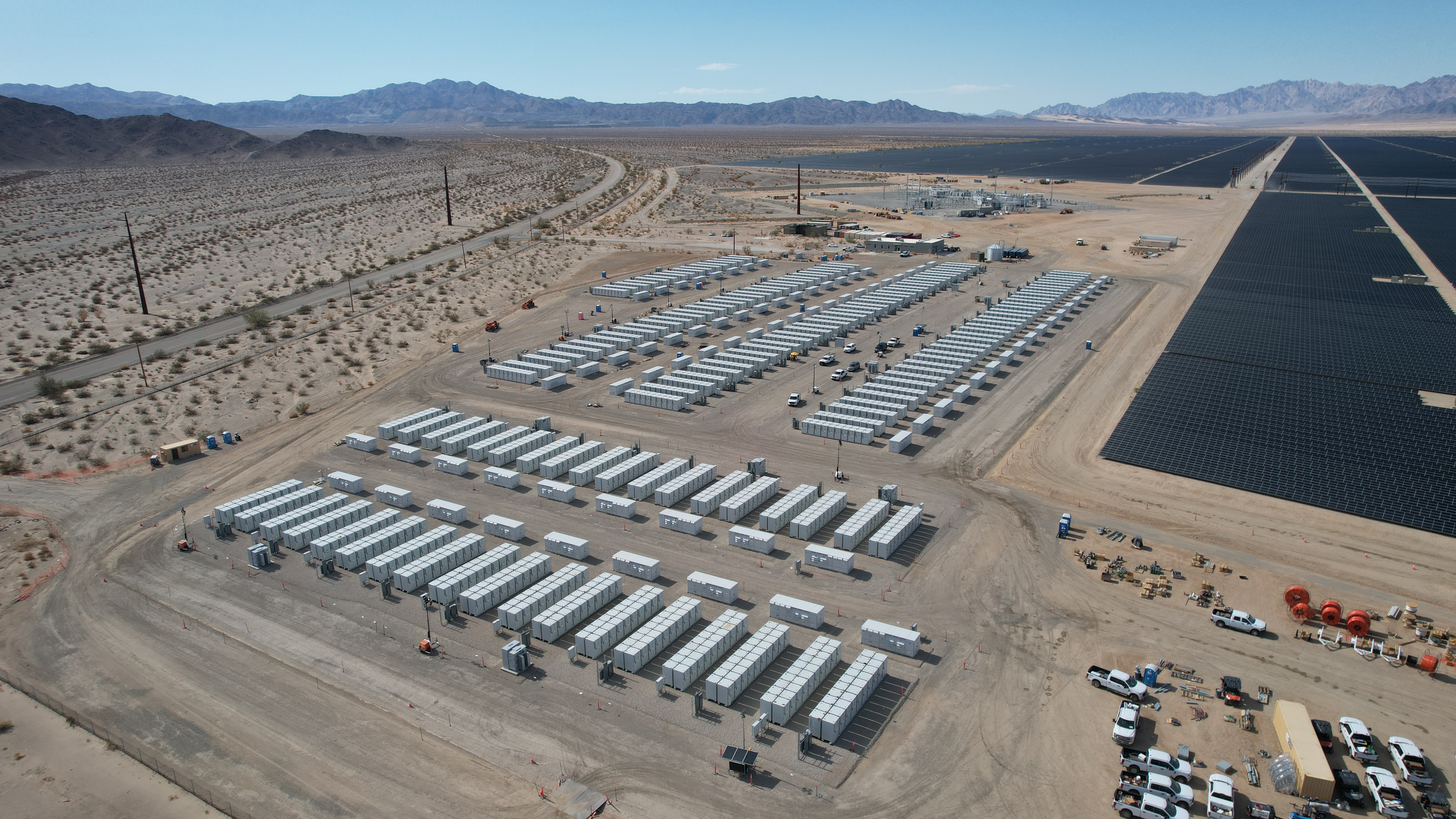
news/2026-06-08-catl-hyperstrong-60gwh-sodium-ion,news/2026-06-09-acp-q1-2026-solar-storage-93pct,news/2026-06-10-ferc-rm26-4-large-load-june-deadline,news/2026-06-11-storage-itc-safe-harbor,news/2026-06-12-pentagon-1260h-solar-battery-additions,news/2026-06-13-ferc-pjm-expedited-interconnection-track,news/2026-06-14-panasonic-de-soto-data-center-pivot. - Cover image: “Desert Sunlight Battery Energy Storage System” by Bureau of Land Management California, Wikimedia Commons, public domain (work of U.S. federal government), July 12 2022.