
Two independent July 4 clocks and one presidential deadline landed inside the same 24 hours. Wood Mackenzie’s post-deadline tally put safe-harbored US utility-scale solar at 216 to 240 GW DC, enough on paper to cover forecast installations through the end of the decade. IRS Notice 2026-15’s FEOC bright line hardened on the same date, moving any post-July-4 US storage license with a specified foreign entity into the effective-control test for Section 48E. Three advanced reactors reached criticality at Idaho National Laboratory under the DOE Reactor Pilot Program, clearing Executive Order 14301’s July 4 target. Enlight closed $2.6 billion of debt on a 1.2 GW Arizona solar-plus-4 GWh storage complex. Commerce is on track to publish CVD finals on July 6 and AD finals on July 13 for cells from India, Indonesia, and Laos, with preliminary margins over 100 percent on the largest lane. The cross-vertical thread: the federal calendar concentrated multi-year sorting decisions on a single date, and the rules that emerged split a fixed inventory of projects into policy-clean and non-eligible tranches.
The lede
Last week the story was nuclear (LevelTen’s Q2 PPA share hitting 42 percent, the NRC’s mandatory-hearings policy statement). This week the story is a single date. Three federal clocks that had been counting down for months struck midnight on July 4, and each one restructures a different vertical for the next 18 months.
The first clock is the One Big Beautiful Bill Act’s begin-construction cutoff for utility-scale solar. Wood Mackenzie’s post-deadline tally put the safe-harbored bank at 216 to 240 GW DC, a paper number but a large one, sized against forecast US installations of roughly the same magnitude through the end of the decade. Projects that beat the deadline sit inside an 18-month placed-in-service window that closes December 31, 2027; new-start greenfield after that date has to run through a tail that Wood Mackenzie’s own read describes as rarely feasible on typical three-year timelines. The post-deadline pipeline is a small residual on top of a large stockpile.
The second clock is inside the same statute, aimed at storage. IRS Notice 2026-15’s single-sentence FEOC provision hardened on July 4: any license agreement a US storage developer enters into with a specified foreign entity after that date will satisfy the effective-control prong of the foreign-influenced entity test, moving the licensee off the Section 48E credit-eligible list. Storage projects that begin construction in 2026 also have to hold a 55 percent material-assistance cost ratio. The two rules interact directly with the paired solar-plus-storage slice of the safe-harbored bank: cell menus that were assumed a month ago are narrower now.
The third clock is nuclear. Executive Order 14301 set July 4, 2026 as the criticality deadline for three advanced reactors authorized under the DOE Reactor Pilot Program at Idaho National Laboratory. Antares Nuclear’s Mark-0, Valar Atomics’ Ward 250, and Deployable Energy’s Unity all cleared it. The reactors are collectively rated below two megawatts electric, so nothing about generation mix moves. What moves is the licensing question: the DOE-authorization pathway has produced three data points and a public political win, and the counterfactual (a failed pilot going into H2 2026) is off the board.
Outside the July 4 stack, three other stories landed. Enlight Renewable Energy closed roughly $2.6 billion of debt on the CO Bar Complex in Arizona (1.2 GW solar, 4 GWh storage, 20-year Salt River Project and Arizona Public Service offtakes), the largest single-site solar-plus-storage financing of this cycle. Commerce is scheduled to publish CVD finals on July 6 and AD finals on July 13 for crystalline-silicon cells from India, Indonesia, and Laos, closing the last unaddressed relocation lanes on Chinese solar routing. And Advanced Energy United’s interconnection reform scorecard gave the seven US grid operators procedural credit and flagged that queued MW are not yet clearing to commercial operation any faster.
Five active verticals this week (solar, storage, nuclear, grid, plus the storage-adjacent edge of critical minerals via the FEOC cell layer). Climate policy and standalone critical minerals were quiet.
Top stories by vertical
Solar: the safe-harbored bank came in at 216 to 240 GW, AD/CVD finals close the last import lanes, and California put $45 million behind the wafer chokepoint
Three stories, one after the other, that together reshape the domestic solar frame across origination, execution, and supply.
Wood Mackenzie’s post-deadline analysis, released July 3, put utility-scale solar safe-harbored between mid-2024 and July 4, 2026 at 216 to 240 GW DC. Camelot Energy Group, working the transformer-radiator lane of the physical-work test, tallied roughly $3.8 billion of safe-harbored equipment on its books between the July 4, 2025 and July 4, 2026 window, corresponding to as much as $200 billion of intended project spend once construction, financing, and interconnection catch up. Wood Mackenzie’s own read: this is enough on paper to cover forecast US installations through the end of the decade, and the post-deadline greenfield tail is small because 18-month placed-in-service windows are rarely feasible on typical three-year utility-scale timelines. (See: news/2026-07-05-safe-harbor-tally-post-deadline.)
The number resets the strategic frame. Deployment volume for 2027 through 2030 comes overwhelmingly from the safe-harbored bank, not from projects the industry has yet to start. Two operational consequences follow. First, the marginal capex dollar in US solar shifts from origination to execution: interconnection queue slots, EPC labor, transformer delivery windows, and financing capacity are now the choke points, not project starts. Second, developers with the strongest interconnection positions on safe-harbored megawatts compound the advantage, and the interconnection-rights premium that has been priced above pure resource quality gets more durable, not less.
The second solar story is trade. Commerce is scheduled to publish final countervailing-duty determinations for crystalline-silicon photovoltaic cells and modules from India, Indonesia, and Laos on July 6, with antidumping finals for India and Indonesia following on or around July 13. Preliminary rates set the anchor: CVD subsidy rates as high as 125.87 percent for India, 104.38 percent for Indonesia, and 80.67 percent for Laos on the February preliminary; AD rates of 123.04 percent for all Indian producers, 35.17 percent for most Indonesian producers with a Blue Sky Solar carve-out at 94.36 percent, and 33.57 percent for Laotian producers on the April preliminary. Imports from the three countries totaled $1.6 billion in 2024, split $817 million India, $423 million Indonesia, and $388 million Laos. The Alliance for American Solar Manufacturing and Trade (Hanwha Q CELLS USA, First Solar, Mission Solar Energy) is the petitioner and has filed a critical-circumstances allegation that, if affirmed, retroactively applies duties up to 90 days before the preliminary. (See: news/2026-07-03-solar-ad-cvd-final-window.)
The structural read holds: the tariff wall around US module supply is being rebuilt case by case, not with a single instrument. AD/CVD extensions into India, Indonesia, and Laos close the arbitrage on the last set of relocation lanes after the Solar IV Cambodia, Malaysia, Thailand, and Vietnam orders. Section 201 lapsed February 6 and Solar IV is doing the trade-remedy work Section 201 used to. For utility-scale developers running the safe-harbored bank into execution, the operative question is not whether the wall exists but where the next hole opens.
The third story is the chokepoint that generalist coverage misses. Graphene & Solar Technologies (OTC: GSTX) disclosed on June 23 that its US subsidiary, The Quartz & Silicon Materials Company, received a $45 million California Competes Tax Credit over five years, tied to planned silicon ingot and silicon wafer manufacturing in California. Section 45X covers wafer production at the federal level, but actual US nameplate is a rounding error against domestic module capacity that is already running into FEOC-driven wafer sourcing constraints. China still controls more than 95 percent of global wafer production. Any US module line trying to qualify for the higher domestic content adder under Section 48E, or to clear the Material Assistance Cost Ratio thresholds for 2026 (40 percent for solar facilities), needs non-FEOC wafer supply that in practice barely exists onshore. (See: news/2026-06-30-gstx-qsm-california-competes-silicon-wafer.)
GSTX itself is small and the milestone risk is live; the $45 million is not enough to underwrite a wafer plant on its own. The signal is policy direction, not execution probability. The marginal state-level capex dollar in US solar manufacturing is now being routed at the ingot-wafer layer. Capacity actually showing up there is a different question and the piece to watch for the second half of the year.
Against the solar thesis frame, the week is thesis-confirm on the supply-chain rebuild vector and thesis-confirm on the safe-harbor stockpile as the binding source of 2027-30 deployment volume. Both were named risks that this week resolved further in the frame’s direction.
Storage / Lithium: the July 4 FEOC bright line hardens the cell layer, and Enlight closes $2.6B against Arizona utility offtake
The FEOC piece is the structurally larger of the two. IRS Notice 2026-15, issued in February to implement the OBBBA foreign-influenced entity regime, contains a single-sentence provision that hardened on July 4: any license agreement between a US storage developer and a specified foreign entity entered after that date will cause the licensee to satisfy the effective-control prong of the FEOC test, moving them off the Section 48E credit-eligible list. Alongside, storage projects that begin construction in 2026 have to hold their material-assistance cost ratio at 55 percent or higher, with the floor stepping up to 75 percent for 2029-start projects. (See: news/2026-07-02-july-4-storage-license-bright-line.)
Three effects show up on the supply side. First, US-domiciled cell manufacturers with in-flight capacity additions get a structural bid: AESC, LG Energy Solution’s Michigan and Arizona lines, Samsung SDI’s Kokomo facility, and the AESC-Prevalon domestic-BESS integration announced in mid-June sit on the right side of the filter. The safe-harbored stockpile’s storage attach demand lands on this cell base. Second, Korean and Japanese suppliers that have restructured ownership and licensing to clear the specified-foreign-entity test become the second tier of credit-safe supply, and the commercial reads for LG, Samsung SDI, Panasonic, and AESC will show what a foreign-supplier structure looks like when it is designed to pass material assistance. Third, Chinese cell suppliers running through joint ventures or licensing arrangements had to close and paper any pre-July 4 licenses before Saturday; anything that slipped past triggers the effective-control test with no soft-landing provision in the notice.
The Enlight CO Bar close is the concrete counterpart to the FEOC frame. Clēnera Holdings reached financial close on June 25 on 1.2 GW of solar plus 4.0 GWh of storage across five projects in northern Arizona, backed by $1.70 billion in term debt from a seven-bank syndicate (BNP Paribas, Crédit Agricole CIB, MUFG, Natixis, Nord/LB, Société Générale, Wells Fargo) plus $1.45 to $1.52 billion of expected tax equity. The complex is anchored by a single 1 GW AC interconnection agreement that clusters five sub-projects under one connection point, and is fully subscribed across five 20-year offtake agreements with Salt River Project and Arizona Public Service. CO Bar 1, 2, and 3 are in construction; 4 and 5 mobilize in 2H 2026, with first commercial operation dates in 2H 2027. (See: news/2026-06-29-enlight-co-bar-26b-arizona.)
Three points read out. First, this is contracted utility offtake at scale in one of the three US states (Arizona, Texas, California) absorbing roughly 80 percent of 2026 storage capacity additions. Arizona alone is on track for about 3.2 GW of new utility storage this year per EIA, and CO Bar’s 4 GWh is a meaningful piece of the 2027-28 deployment year. Second, the interconnection structure is the model worth watching: anchor a large grid connection, then cluster multiple sub-projects under the same point. That is exactly the pattern the AEU scorecard says is not yet clearing throughput in the aggregate but is available to developers with portfolio depth. Third, seven global banks underwriting $1.7 billion of term debt against 20-year utility offtake is the LFP cathode demand signal that gets ignored: 4 GWh of installed storage in 2027-28 pulls multi-thousand tonnes of lithium carbonate equivalent at modern energy densities, and it is now financed paper, not a press release.
Piece worth tracking on CO Bar: which cell suppliers Enlight discloses, particularly any disclosure of domestic-content sourcing under the 45X production credit and 48E investment credit. Domestic-content qualification at this scale changes the per-MWh tax equity math for every comparable project still working its capital stack. The FEOC filter and the 55 percent material-assistance floor sit on top of that math.
Against the storage / lithium thesis frame, this is thesis-confirm on the structural-integration vector and thesis-confirm on the supply-chain rebuild vector. Both moves are inside the frame; the FEOC bright line is the discrete step, not a step change, that the framing has been pointed at since Notice 2026-15 published in February.
Nuclear: three DOE-authorized reactors reach criticality; the pathway question resolves
Antares Nuclear’s Mark-0 (a 500 kilowatt-thermal sodium heat-pipe microreactor), Valar Atomics’ Ward 250 (a 100 kilowatt-thermal helium-cooled unit), and Deployable Energy’s Unity (a 1 megawatt-electric water-moderated gas-cooled “nuclear battery”) all achieved criticality at Idaho National Laboratory between early June and the first days of July. Mark-0 is the first privately developed non-light-water reactor to go critical on US soil in more than four decades. INL Director John Wagner called the Unity timeline (roughly 150 days from selection to criticality) “a remarkable accomplishment.” Energy Secretary Chris Wright framed the milestone as “a significant milestone on a timeline many thought was unachievable.” (See: news/2026-07-04-doe-pilot-three-reactors-criticality.)
The megawatts do not matter here. The three units are collectively rated below two megawatts electric and nothing about this week’s news changes the near-term US generation mix. What changed is the licensing question. Executive Order 14301 stood up a DOE-authorization pathway that runs parallel to the NRC’s Part 50 and Part 53 processes, using DOE’s existing authority over test and demonstration reactors sited on federal facilities. The pilot was designed to prove that pathway. It did. Three private developers ran through DOE authorization, sited hardware at INL, and reached criticality on schedules that would have been implausible under a conventional NRC review. Antares went from selection to criticality inside a calendar year.
Three second-order signals to watch as the pilot reads through to commercial deployment. First, the remaining seven pilot developers (Oklo Aurora-INL at 75 megawatts electric, Terrestrial Energy Project Tetra at 195 megawatts electric, Aalo Atomics, Atomic Alchemy, Deep Fission, Last Energy, Natura Resources) now sit inside a program the White House and DOE will point to as a success template. That raises the political cost of delay on subsequent authorizations and increases the odds of the next round moving faster. Second, whether Congress or the executive branch extends the DOE-authorization frame beyond a test-reactor pilot into a durable statutory pathway for commercial deployment. The pilot has no built-in commercial extension; scaling requires either NRC licensing on the back end or a legislative extension of DOE authority to authorize non-test units, and both routes are now in play in a way they were not a week ago. Third, and closest to the demand thesis: hyperscaler procurement contracts signed against future advanced-reactor output (the Amazon and X-energy, Microsoft and Kairos, Google and Kairos frames from Q2 alone) depend on a credible near-term deployment path. The pilot does not directly move any of those developers’ schedules. It does move the base rate at which counterparties, insurers, and utility offtakers underwrite advanced-reactor completion risk.
Against the nuclear thesis frame, this is thesis-confirm and stacks on top of last week’s NRC mandatory-hearings policy statement. Two consecutive weeks in which the timeline-compression axis of the advanced reactor story moved down; the Carnegie gap on the demand side stays large but the supply-side latency starts to look answerable.
Grid: AEU scorecard says reform is happening; throughput isn’t
Advanced Energy United’s June 23 progress report on generator interconnection reform graded the seven US grid operators. SPP and CAISO earned “promising improvements.” PJM, ISO New England, and NYISO were rated at “expected progress.” ERCOT drew “incremental progress.” MISO was called “incomplete.” The interesting part of the report is what it does not say. Nowhere in the scorecard is there evidence that interconnection requests, once submitted, are actually reaching commercial operation faster than in prior cycles. Reform has changed the shape of the queue, not yet its throughput. (See: news/2026-07-01-aeu-interconnection-reform-scorecard.)
Cluster studies and first-ready-first-served rules mandated by FERC Order 2023 are now live at every RTO. Gating deposits and readiness milestones have culled speculative projects at the front. AEU characterizes this as “shifting more viable projects up in the queue,” a real gain for developers with financing and site control, a smaller gain if the question is megawatts hitting the grid.
Two friction points sit in the report. Fast-track pathways at MISO, PJM, and SPP have opened a two-tier queue where projects with utility, state, or federal priority get a lane and comparable projects sit in the standard queue. AEU flags “potential for discrimination” that FERC has not yet arbitrated durably. Separately, the grid operators are negotiating a FERC track on large-load interconnection, driven by data-center peak-load applications that reached 198 GW in ERCOT alone in Q1 2026. That process, still in comment phase, is where the throughput question actually resolves: whether a 500 MW hyperscaler campus is treated as a generator, a load, or a hybrid.
The read for the supply chain: reform without throughput is the status quo. If US battery, solar, and firm-capacity buildouts are gated by transmission queue times, the marginal winners are projects with existing interconnection rights, brownfield sites, or grid-adjacent land. Those attributes were already priced above pure resource quality. The AEU report is another data point that the premium is real and durable.
Against the grid thesis frame, this holds. FERC Docket RM26-4-000 on large-load interconnection remains the substantive event to watch; Order 2023 was procedural.
Framework check
Solar (IRA implementation thesis). Resolves further in the frame’s direction. Wood Mackenzie’s 216 to 240 GW safe-harbor tally sizes the pre-cutoff stockpile at forecast-installation scale through 2030. The post-deadline pipeline is a small residual on top of a large bank. Frame intact; the binding constraint is now inside the bank (execution, interconnection, cell menu under FEOC), not project starts.
Solar (risk: interconnection reform stalls). No relief this week. The AEU scorecard is procedural credit without throughput improvement. Named risk holds; watch FERC Docket RM26-4-000 for substantive action.
Solar (risk: trade-remedy gaps let Chinese cells reroute). Narrows this week. Solar IV AD/CVD extensions into India, Indonesia, and Laos close the last relocation lanes on top of the Cambodia, Malaysia, Thailand, Vietnam orders. Preliminary margins over 100 percent on the largest lane functionally close the India route. Frame intact and tightening.
Solar (risk: wafer chokepoint keeps binding). Named-and-funded at the state level this week via the $45 million California Competes credit to GSTX/QSM USA. Federal-level Section 45X coverage exists; nameplate does not. Risk holds; watch whether QSM USA pairs the state credit with a federal 45X election, a DOE Loan Programs Office application, or a private US cell-maker offtake.
Storage / Lithium (structural integration vector). Strengthens on two axes. Enlight CO Bar closes $2.6 billion of debt against 20-year utility offtake on 4 GWh of storage, the model for anchor-interconnection-plus-clustered-subprojects. Federal calendar hardens the FEOC filter on cell supply. Frame intact and broadening.
Storage / Lithium (risk: FEOC filter narrows cell menu). Named and hardened this week. The July 4 bright line under Notice 2026-15 is the discrete step, not a step change. Watch the December 31 Treasury PFE-specific safe-harbor tables for the next round of resolution.
Storage / Lithium (risk #4: alt-chemistry captures grid-storage share). No movement this week. CATL-HyperStrong 60 GWh sodium-ion offtake from June remains the only weight-bearing marker. A second non-Chinese offtake at 30 GWh-plus would flip the risk from named to actively contested.
Nuclear (renaissance thesis). Strengthens. The DOE pilot proved the parallel-authorization pathway with three criticalities. That is a validation, not a scale event, but the counterfactual (a failed pilot) is off the board. Combined with last week’s NRC mandatory-hearings policy statement, two consecutive weeks of supply-side timeline compression.
Nuclear (risk: NRC throughput stays binding). Held down. No direct new NRC news this week; last week’s Section 207 implementation still the anchor.
Nuclear (risk: DOE pilot pathway fails to scale beyond test reactors). Named this week for the first time in the frame. The pilot is capital-light and technically narrow, and scaling requires either NRC licensing on the back end or a legislative extension of DOE authority to authorize non-test units. Watch Congress and the executive branch for statutory extension activity in H2 2026.
Grid (throughput vector). No improvement this week. AEU scorecard confirms procedural reform is live but queued MW are not clearing faster. Frame intact; the substantive event is still ahead at FERC.
Critical Minerals. Quiet this week at the standalone-vertical level. The FEOC storage bright line touches the cell layer, which touches lithium and nickel and cobalt sourcing, but the primary rare-earth and heavy-separation stories held. Last week’s China Ministry of Commerce action on MP Materials and USA Rare Earth remains the active marker; watch for the next round of federal capital placement on heavy separation.
Climate Policy (IRA implementation thesis). No new headline this week. OBBBA solar and storage clocks are the operative implementation surfaces; both landed this week and both resolved in the frame’s direction.
Net read: thesis intact across all active verticals. Two risks moved down (solar new-start risk given the safe-harbor tally, and the Solar IV routing-arbitrage risk). One risk was formalized without stepping up or down (the storage FEOC filter). One risk was named for the first time (the DOE pilot commercial-scale question). No risk stepped up this week.
Cross-vertical thread
The thread of the week: the federal calendar concentrated multi-year sorting decisions on July 4, and the rules that emerged sort a fixed inventory of projects into policy-clean and non-eligible tranches. Three federal clocks bound simultaneously (safe-harbor cutoff on solar, FEOC bright line on storage, DOE pilot criticality on nuclear), and each one produced a definitional split in the inventory it governs.
For solar, the split is safe-harbored versus greenfield. The 216 to 240 GW that made it through is a large enough number that Wood Mackenzie’s own forecast has the sector covered through the end of the decade on the stockpile alone. Everything downstream (interconnection queue behavior, EPC labor pricing, transformer delivery, financing capacity, the AEU scorecard’s throughput problem) becomes a story about execution inside a fixed inventory rather than about origination. The interconnection-rights premium on safe-harbored megawatts is now the marginal price signal in US utility-scale solar for the next 18 months.
For storage, the split is FEOC-clean versus FEOC-exposed cell supply. The Notice 2026-15 provision routes marginal cell procurement toward AESC, LG Energy Solution US, Samsung SDI Kokomo, Panasonic, and the AESC-Prevalon domestic integration path. Chinese cell suppliers that did not close and paper their US license agreements before Saturday are outside the effective-control-safe list. The Enlight CO Bar close is the concrete case: 4 GWh of storage attached to safe-harbored solar, contracted 20 years with SRP and APS, financed by seven global banks against tax equity, will have its cell supplier disclosed in a market that has just narrowed the credit-eligible menu.
For nuclear, the split is DOE-authorization versus NRC-only. The three criticalities are the proof that a parallel pathway works and reduces license-time risk from selection to first fuel. The remaining seven pilot developers now operate in the shadow of a public political win, and the counterparties, insurers, and utility offtakers underwriting advanced-reactor completion risk have a new base rate to price against. The Q2 LevelTen tracker last week put hyperscaler nuclear PPA share at 42 percent for the first time on record. The DOE pathway is now the mechanism through which some meaningful fraction of that contracted MW might actually meet its commercial-operation date.
Three splits, one date. The pattern that connects them is that each rule sorts a definite pool of projects rather than creating new headroom. The safe-harbor tally is a stockpile, not a growth engine. The FEOC bright line filters the existing cell base, not new cell capacity. The DOE pilot proves a pathway on the test-reactor cohort, not on the commercial fleet. What each rule does is compress the range of outcomes inside the inventory it governs.
Two negative-space observations. First, no major hyperscaler PPA announcement this week, no major FERC ruling, no new DOE loan. The signal cluster was on statutes and executive orders that had been telegraphed for months, printing on schedule. Second, critical minerals had no primary headline; last week’s China Ministry of Commerce action on MP Materials and USA Rare Earth carries the frame forward, and the FEOC rule at the cell layer is the closest read-across into the minerals stack this week. Track marginal, watch policy, ignore most price noise: this week the marginal move was policy on the calendar, and the price signal is downstream of it.
Watch list: week of July 6 to July 12, 2026
- Commerce final CVD determinations on solar cells from India, Indonesia, and Laos, July 6. Watch whether Commerce keeps the outsized India margins (up to 125.87 percent) intact or narrows them under respondent challenge. A material downward revision on India would soften the near-term pricing shock. Whether the critical-circumstances allegation is affirmed determines retroactive cash-deposit exposure back to 90 days before the preliminary. (Solar.)
- 8-K cadence on physical-work-of-significant-nature disclosures for the safe-harbor stockpile. The week’s disclosures will start to size which developers actually beat the July 4 deadline and how much of the 216 to 240 GW tally is concentrated among top-tier IPPs versus mid-market originators. Concentration matters for interconnection-slot competition through 2027. (Solar.)
- Any cell-supplier disclosure from Enlight/Clēnera on the CO Bar Complex. With 4 GWh of storage contracted, the disclosed cell menu is a real-time read on which US-domiciled or FEOC-compliant suppliers are winning the safe-harbored storage-attach volume. (Storage / Lithium.)
- Congressional and executive-branch signals on extending the DOE Reactor Pilot authorization pathway beyond test units. The path scales through statutory extension or NRC handoff. Watch committee schedules and White House readouts for statutory-extension language in H2 2026 legislative activity. (Nuclear.)
- FERC Docket RM26-4-000 next-step signals. The AEU scorecard flagged this as the substantive throughput event still ahead. Any post-June 18 procedural motion or scheduling notice from FERC on large-load interconnection is the readout to track. (Grid.)
- Second sodium-ion commercial offtake outside China. Still the missing data point. Continued absence keeps the alt-chemistry risk named-but-not-active; a first move here flips the picture on the storage risk frame. (Storage / Lithium.)
Clean Power Press is editorial, not advisory. Nothing here is a recommendation. Positions, prices, and projects move; we cover how to think about them.
Sourcing log
- Wood Mackenzie, “The state of safe harboring: a strategic outlook for US utility-scale solar development,” post-deadline analysis, July 3, 2026.
- IRS Notice 2026-15, FEOC material-assistance guidance under the One Big Beautiful Bill Act, February 2026 (July 4, 2026 bright line date).
- U.S. Department of Energy, DOE Reactor Pilot Program criticality announcements at Idaho National Laboratory, June and July 2026.
- U.S. Department of Commerce, International Trade Administration, preliminary CVD and AD determinations for crystalline-silicon photovoltaic cells and modules from India, Indonesia, and the Lao People’s Democratic Republic; final CVD scheduled July 6, 2026.
- Enlight Renewable Energy press release, CO Bar Complex financial close, June 25, 2026 (GlobeNewswire).
- Advanced Energy United, generator interconnection reform progress report, June 23, 2026 (Utility Dive coverage).
- Graphene & Solar Technologies 8-K, June 23, 2026 (SEC EDGAR).
- Prior digest framework, watch list, and named risks:
posts/weekly-2026-06-28.md. - Vertical thesis frames: project file
vertical-thesis-frames. - In-period news flashes:
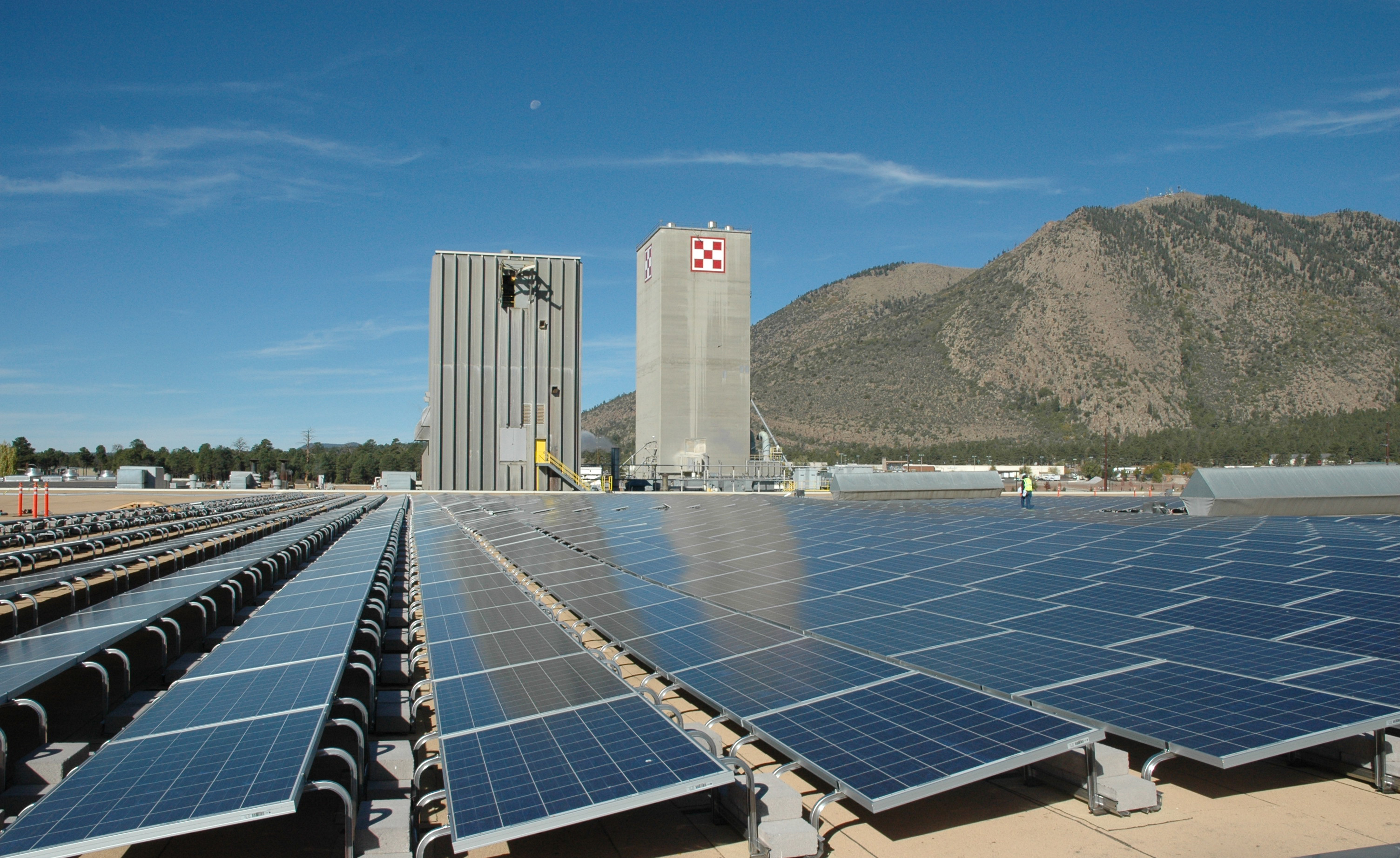
news/2026-06-29-enlight-co-bar-26b-arizona,news/2026-06-30-gstx-qsm-california-competes-silicon-wafer,news/2026-07-01-aeu-interconnection-reform-scorecard,news/2026-07-02-july-4-storage-license-bright-line,news/2026-07-03-solar-ad-cvd-final-window,news/2026-07-04-doe-pilot-three-reactors-criticality,news/2026-07-05-safe-harbor-tally-post-deadline. - Cover image: “Nestle Purina’s solar farm in Arizona” by Purina employee, Wikimedia Commons, CC BY-SA 3.0, uploaded January 12, 2015.