
Exactly one month behind the tape. The One Big Beautiful Bill Act, enacted July 4, 2025, terminated the Section 45Y production tax credit and the Section 48E investment tax credit for wind and solar facilities that begin construction after July 4, 2026 and are placed in service after December 31, 2027. The July 4, 2026 deadline is the single hardest calendar edge in the current renewable capital stack. Every project that filed a begin-of-construction claim on or before that date is inside the credit regime on its old terms. Every project that missed the date is in the post-July 4 bucket, which is a Dec 31, 2027 placed-in-service race with no continuity safe harbor extension available.
The operating document that decides which projects cleared the deadline is not the statute. It is Treasury Notice 2025-42, issued August 15, 2025 and effective September 2, 2025 on a prospective-only basis. The Notice rewrote the begin-of-construction mechanic for wind and solar Section 45Y and 48E credits, and it is what tax-equity counsel is reading against every project’s construction file this month.
The three placed-in-service buckets
The OBBBA plus Notice 2025-42 stack creates three separate placed-in-service deadlines for wind and solar facilities claiming the 45Y PTC or the 48E ITC, and every 2026 project sorts into exactly one bucket.
The first bucket is projects that began construction on or before December 31, 2025 and rely on the continuity safe harbor of Notice 2022-61. Those projects have a placed-in-service deadline of December 31, 2029. This is the four-year continuity safe harbor at its most generous, and it applies to the pipeline of projects that safe-harbored under the pre-OBBBA rules during 2024 and 2025. Notice 2025-42 was drafted prospectively for a reason: Treasury preserved the pre-existing safe harbor for projects already committed on the old rulebook.
The second bucket is projects that began construction between January 1, 2026 and July 4, 2026, again relying on the four-year continuity safe harbor. Those projects have a placed-in-service deadline of December 31, 2030. This is the bucket that saw the compressed first-half 2026 construction push. The physical work test was in play for the entire H1 2026 window, and the 5 percent cost safe harbor was still available through the September 2, 2025 effective date of Notice 2025-42 for solar facilities at or below 1.5 MWac. Above 1.5 MWac, and for all wind, the September 2, 2025 effective date closed the cost safe harbor and forced projects into the physical work test to lock a pre-July-4 begin-of-construction date.
The third bucket is projects that began construction after July 4, 2026. Those projects have a placed-in-service deadline of December 31, 2027. There is no continuity safe harbor extension inside the statute for this bucket. A project that begins construction on August 4, 2026, one month past the deadline, has 17 months to reach placed-in-service to earn the credit. That timeline does not clear a utility-scale solar interconnection queue in any of the seven major ISOs on current published lead times. In practice, the third bucket is not a credit-eligible pipeline for utility-scale projects. It is a pipeline of small solar (rooftop, community, sub-1.5 MWac ground-mount) plus a narrow set of distributed wind installations where 17-month construction is achievable.
The market’s H1 2026 construction surge was a run at the second bucket, not the third. The tape is now reading which projects actually landed inside the second bucket on defensible physical work test evidence.
What Notice 2025-42 changed about begin-of-construction
Pre-OBBBA, projects had two routes to a begin-of-construction date. The physical work test required physical work of a significant nature either onsite or at a factory building custom project components. The 5 percent cost safe harbor required the taxpayer or a related contractor to pay or incur at least 5 percent of the total cost of the facility. Either route, if satisfied and combined with continuous efforts to complete construction, established the begin-of-construction date and started the four-year continuity safe harbor clock.
Notice 2025-42 eliminates the 5 percent cost safe harbor for two categories of facility: solar facilities with a maximum net output exceeding 1.5 MWac, and all wind facilities regardless of size. For those facilities, the physical work test is the only route to begin-of-construction. The 5 percent cost safe harbor remains available only for solar facilities at or below 1.5 MWac. Every utility-scale solar project and every wind project claiming a pre-July-4 begin-of-construction date must now defend that date on physical work test evidence, and only physical work test evidence.
The physical work test itself was not rewritten. The Notice preserves the pre-existing test’s structure: physical work of a significant nature, performed either onsite by the taxpayer or by third parties under a binding written contract, or offsite at a manufacturer building custom components for the specific project. The Notice also preserves the four-year continuity safe harbor: a project satisfies the continuity requirement automatically if it is placed in service by the end of the fourth calendar year after the calendar year in which construction began. Excusable disruptions (permitting delays, interconnection delays, natural disasters, supply shortages, financing issues) do not disqualify projects from meeting the continuous construction requirement.
What changed is who has to defend the begin-of-construction date on physical work evidence alone, and that population is now every wind project and every solar project above the 1.5 MWac threshold that filed a pre-July-4-2026 claim.
Onsite physical work: what counts
Treasury guidance on qualifying onsite physical work for solar facilities identifies three specific activity categories that qualify:
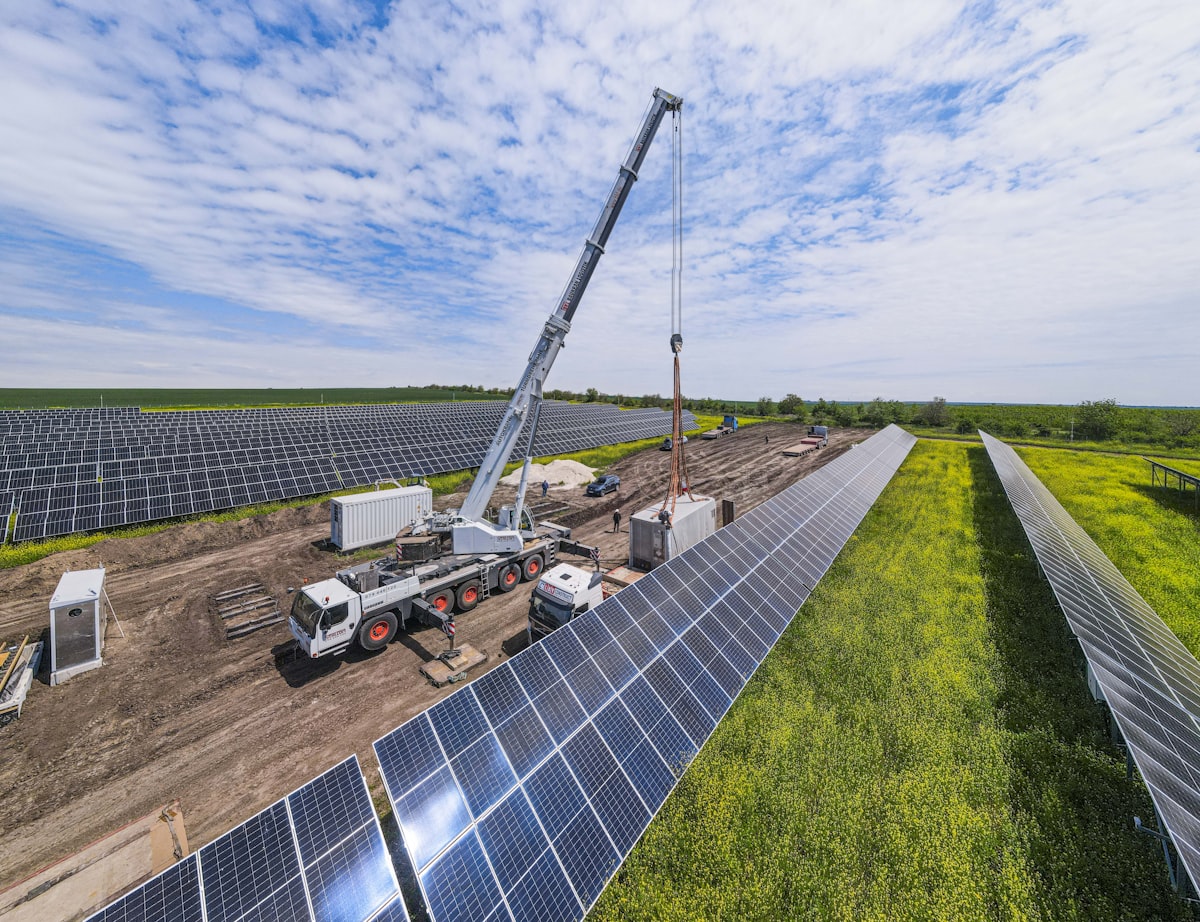
Installation of racks or other structures to affix photovoltaic panels, collectors, or solar cells. This is the anchor activity for most utility-scale claims. Rack installation is measurable, dated by contractor invoices and daily site logs, and produces physical evidence (installed steel in the ground) that is difficult to backdate. A rack installation begin date, supported by contractor invoices, driller reports, and photographic evidence with GPS-tagged timestamps, is the strongest onsite physical work claim available.
Pouring foundations. Solar racking foundations, inverter pad foundations, substation foundations, and O&M building foundations all qualify. A concrete pour is discrete, dated by batch tickets, and physically permanent. Foundation work is a common backup or supplemental claim behind rack installation.
Building maintenance roads. Site access road grading and gravel base work qualifies as physical work of a significant nature. This is the most flexible activity because it is often already scheduled early in a construction sequence for equipment access. Grading contractor logs and material delivery tickets provide the evidentiary base.
For wind facilities, the analogous onsite categories are turbine foundation excavation and concrete pour, tower crane pad construction, and access road grading. The evidentiary structure is the same: contractor invoices, daily site logs, batch tickets, photographic evidence.
Offsite physical work: what counts and what does not
The offsite manufacturing route is narrower than most H1 2026 begin-of-construction claims read. Offsite work qualifies only for custom components manufactured specifically for the project. Treasury guidance identifies custom transformers, switchgear, and custom power conditioning equipment as the paradigm examples. The critical exclusion is stockpiling standard inventory items. If a component is normally held in inventory by the vendor, physical work on that component does not qualify as begin-of-construction physical work for the project, no matter how much money the project paid for it and no matter when the vendor started manufacturing.
This is the specific evidentiary gap the tax-equity market is now trading around. A project that filed a July 3 begin-of-construction claim on the basis of an offsite manufacturing start at a solar module factory has a defensibility problem. Solar modules are held in inventory. A polysilicon-to-module manufacturing start on a standard module SKU does not clear the offsite test. The claim needs to sit on a custom transformer at a specific vendor, a custom switchgear assembly at a specific vendor, or a custom power conditioning system with project-specific specifications documented in a binding written contract dated before July 4, 2026.
Racking is a closer call. Utility-scale racking is often built to project-specific tilt angles, GCR (ground coverage ratio) specifications, and terrain-following geometry, which can push it into the custom category. But standard fixed-tilt racking on a standard row length and standard pier spacing is a harder defense. The market read on racking-based offsite claims is project-by-project, and it depends on the specific rack manufacturer’s inventory practice and the specific binding written contract terms.
The evidentiary shape tax-equity is now underwriting
Every project claiming a pre-July-4 begin-of-construction date is being asked to produce a construction file with three specific document categories. First, a contemporaneous set of contractor invoices, daily site logs, batch tickets, delivery tickets, and GPS-tagged photographic evidence establishing that qualifying physical work of a significant nature was performed on or before July 4, 2026. Second, the binding written contracts under which that work was performed, dated on or before the physical work start date, with terms that establish the project-specific nature of any offsite component work. Third, a continuity plan and a project schedule showing the trajectory to placed-in-service inside the applicable continuity safe harbor window (December 31, 2029 for the pre-2026 begin-of-construction bucket, December 31, 2030 for the H1 2026 bucket).
The invoices and site logs are the hard evidence. The binding written contracts are the legal frame. The continuity plan is what the tax-equity party underwrites the credit against, and it is where the market is now doing the most work. Interconnection queue positions, transmission upgrade schedules, module and racking delivery windows, and construction labor availability all feed the continuity plan, and each one is a source of potential slippage inside the four-year window.
The one item still open
Foreign Entity of Concern (FEOC) rules are the piece of the OBBBA framework that Notice 2025-42 did not address. Treasury indicated at the time of the Notice’s release that additional guidance on FEOC implementation was in drafting. The FEOC rules restrict credit eligibility for projects with certain ownership, financing, or component-sourcing ties to designated foreign entities (China, Russia, and others). The rules affect both the credit-eligibility determination and the transferability market for the credit under Section 6418. Every construction file being underwritten this month has a FEOC review pending, and the pending guidance is the single largest known open item in the post-July-4 tape.
The projects inside the first two buckets have their placed-in-service clocks running. The physical work test decides which projects made it in. The FEOC guidance, when it lands, decides which of those projects can actually monetize the credit. That is the piece of the stack the market is still waiting to price.
Sources
- Treasury / IRS Notice 2025-42, issued August 15, 2025, effective September 2, 2025 (prospective).
- One Big Beautiful Bill Act, Pub. L. 119-21, enacted July 4, 2025 (amendments to Sections 45Y and 48E).
- Notice 2022-61 (continuity safe harbor for pre-OBBBA begin-of-construction claims).
- Internal Revenue Code Sections 45Y, 48E, and 6418.